fbpx

Second phase of Light Waterfront project to be completed by 2022

Property News/ 30 May 2015 No comments

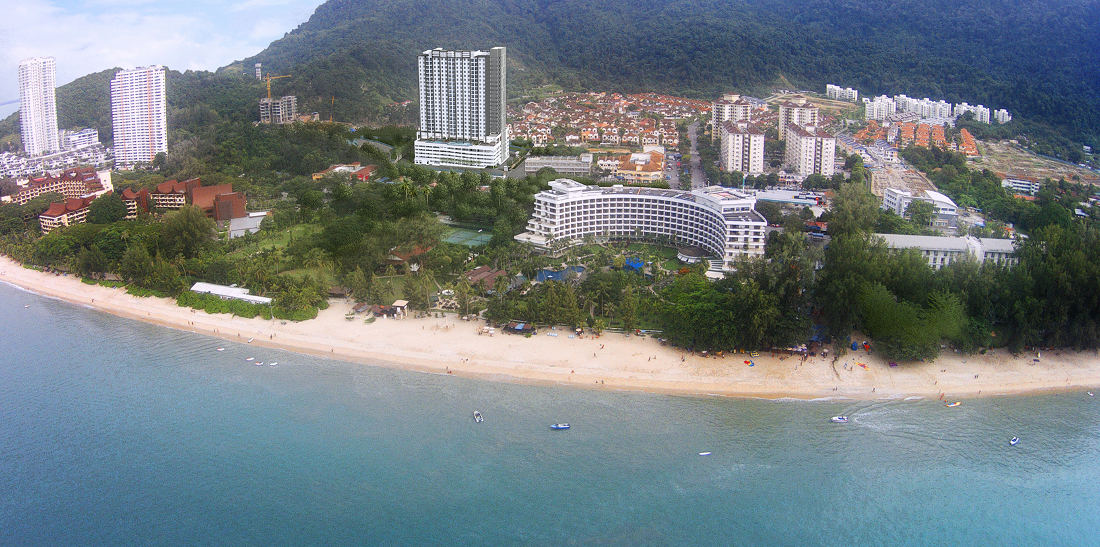
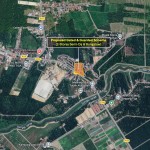
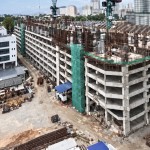
IJM Land northern region senior general manager Datuk Toh Chin Leong said the group and Singapore-based Perennial Real Estate Holdings Ltd (PREH) had teamed up to acquire and develop the freehold waterfront project with a gross development value of RM4 billion.

“The 13.26-hectare site in Gelugor will be developed into a large-scale integrated mixed-used development. We expect the project to start next year and be completed by 2022,” he told reporters after the official joint-venture signing ceremony between IJM Land and PREH, in George Town yesterday.

Toh said the total development cost for the project was estimated to be over RM3 billion with a majority of it being up for sale.

“The development will boost Penang’s tourism and transform the state’s waterfront landscape to the forefront among investors and tourists,” he added.

Meanwhile, PREH chief executive officer Pua Seck Guan said the prime sizeable development also presents a unique opportunity to establish a one-stop retail-cum-lifestyle destination, imbued with the life and spirit of Penang’s cultural heritage.

“The joint-venture in Penang also marks our first foray into a new market, which will augment our existing business in the core markets of China and Singapore, and diversify our investment portfolio to generate sustainable returns over the longer term,” he added.

The project is described as Penang’s first mega integrated waterfront icon with retail, entertainment, recreational, residential, business, hospitality and Meetings, Incentives, Conventions and Exhibitions components.

Source: Bernama

Tags:

Helping the poor own houses

Property News/ 30 May 2015 No comments

Buying home is typically the largest and most complicated financial commitment most people will ever make”. This is the phrase used whenever there is talk of homeownership and it applies to low-income households, too.

First-time buyers face many barriers, one of them being the burden of monthly payments, having enough savings to sustain the responsibilities of owning a house, and income stability to qualify for housing loans.

Even if they do qualify, potential buyers may be hampered by a lack of affordable homes in a preferred location or even information on how to buy a home.

While the basics of acquiring a home is accessible to the educated and higher-income group, the low-income households do not have access to such information and perhaps have no idea about how to become homeowners. Lower-income group will stand to lose their homes if they are unable to keep up with payments.

There are also reports of low-cost housing projects turning into slum-like housing after several years.

While extending homeownership to the low-income households is a priority, issues like banking, financial management and education cannot be ignored.

Information on affordable housing

In the past five decades, scores of low-cost housing project schemes and funding plans have been introduced in Malaysia. Information on low-cost projects, those under construction or planned by the various low-cost housing providers, state economic agencies, federal bodies and funding schemes, should be made available to the public in a database. This will allow individuals to learn about the availability of affordable housing in their communities and the financing options available.

Single ‘umbrella’ to coordinate distribution and availability

It seems that the local councils and land offices have their own respective directives from their state government to impose a mandatory “low-costs housing” category. Have they have been overzealous in carrying out the directives? Has anyone make a last count of low cost units that are available in the market? Has there been overhang of such properties?

Why isn’t there a single umbrella (federal) or data bank where information can be collected to coordinate the total numbers of such units being built, the location and pricing? “They must build the right product at the right place with the right pricing and the right numbers. ”– National House Buyers Association

No racial profiling

We have time and again reiterated that there should be no racial profiling in low-cost, low-medium cost or those under the category of affordable housing scheme. We must stick to the adage that “whoever deserves a house must get a house”.

Balancing the risks

Buying and owning a house is a riskier proposition for households compared with renting. Buyers take on enormous debts, sign multi-year loan agreements and become responsible for homeowners’ cost of their homes.

Newspapers have printed proclamation of sales or units for public auction and a large portion of the properties are below RM50,000 with some going below RM10,000. Banks have also upload cases of foreclosure properties on their website.

CIMB’s list of properties up for public auction showed 35 units of properties in Selangor at reserved price of less than RM42,000, i.e the price of a new low-cost unit.

Low-cost units being auctioned for half or more than half the price they were sold is an alarming trend. Unfortunately, there are no official statistics on how many low income earners have lost their homes or not being able to finance their purchase promptly. Where do these homeowners and their families end up living?

Foreclosures can devastate a family’s economic and social standing, leaving them poorer instead. Making sure lower income households have sufficient personal financial management skills is more than a supplementary issue. Financiers, local authorities and communities benefit from homeowners being better informed of their rights and responsibilities as homeowners and borrowers. Support for potential home buyers and owners is crucial.

Counselling programmes

Bank Negara has since April 2006 set up the Credit Counselling and Debt Management Agency (Agensi Kaunseling dan Pengurusan Kredit – AKPK:http://www.akpk.org.my/my/perkhidmatan/pengurusan-kredit/pengenalan)

to provide counselling and debt management to individuals as well as financial education to help individuals take control of their financial situation.

We recommend that a similar programme – Homeownership Education Programmes to be set up to raise overall financial literacy as a method to prepare low-medium income households to take on the responsibilities of owning a home, so that the hard task of ensuring a “home for everyone” be maintained and house owners do not end up being “squatters” again.

Homeownership education can be in the form of manuals to be handed out, advice and information given out by telephone, workshops or “face-to-face” counselling.

These services should ideally be provided before a potential buyer signs a purchase contract. Counselling should be provided to help households maintain their homes or to manage their finances.

It is not enough just to provide homes for the low-income group who are also first time buyers on the many aspects of homeownership.

The success of any public housing programmes can be achieved by assisting the lower income group to acquire and remain homeowners.

We recommend that potential buyers to be trained to take responsibilityof ownership.

A Homeownership Education Programme could probably include the following:

Pre-purchase education:

  • Understanding the process of buying a house
  • Evaluating household needs
  • Understanding housing types
  • Understanding the loan process
  • Financial preparation

Post-purchase education:

  • Budgeting monthly expenses
  • Making payments promptly
  • Avoiding loan defaults
  • Living within a community
  • Social responsibility
  • Property taxes, assessments
  • Insurance, service charges, sinking fund
  • Home maintenance
  • Handling problems with the property

This recommendation is intended to encourage all potential first-time low-medium cost homebuyers to attend a homeownership education programme before they search for a home or sign a sale and purchase contract.

Educate yourself and learn from the mistakes of others to avoid being disappointed or worse, “house poor”.

Chang Kim Loong is the secretary-general of the National House Buyers Association (HBA): www.hba.org.my, a non-profit, non-governmental organisation manned by volunteers.

Source: TheStar.com.my

Tags:

Titijaya acquires Penang land to develop RM2.6 bil development

Property News/ 29 May 2015 1 comment

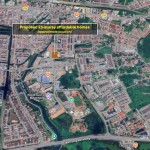
Titijaya Land Bhd obtained shareholders’ approval to acquire about 23 acres of leasehold land in Batu Maung, Penang to build a mixed-use development after its extraordinary general meeting (EGM) here today. The land is located within 1.5km from the Sultan Abdul Halim Mua’dzam Shah Bridge (the Second Penang Bridge).

The mixed-use development will be built by Titijaya Land’s wholly-owned subsidiary, City Meridian Development Sdn Bhd and is the group’s first development outside of the Klang Valley.

“The property market in Penang is highly competitive, but we believe that the demand for residential and commercial properties in Penang is expected to remain favourable among local and foreign buyers,” deputy group managing director Lim Poh Yit (pictured, right) told reporters after the EGM.

The land acquisition will be satisfied via a cash consideration of RM126 million in bank borrowings and internal funds.

The newly acquired landbank will be used to develop a proposed mixed-use development with a gross development value (GDV) of about RM2.6 billion. The proposed development, which is yet to be named, will offer about 1,700 small office, home office units across four blocks, retail components and four office towers.

According to GDP Architects Sdn Bhd’s associated partner Hairul Afzahizan Osmayati (pictured, below), the development will be built in three phases.

“We phased out the developments into three [phases]. The first phase will have two residential blocks with retail and shops; Phase 2 will be the remaining retail and two residential blocks. The last phase will be [all four] office [towers],” said Hairul. GDP Architects is the appointed master architect for the whole project.

Lim said: “We plan to launch Phase 1 this year. It will be either year-end or early next year, which is our launching schedule.” He added that the first phase will have an estimated GDV of RM600 million.

Lim is aiming to obtain approval from the authorities to develop the project by early next year.

After the land acquisition, Titijaya Land has 432.47 acres of landbank throughout Malaysia.

“We believe that this acquisition will expand our development activities in the future, which will contribute positively to the group’s future financial performance,” Lim added.

Source: TheEdgeProperty.com

Tags:

Eco World to launch first Penang project next month

Property News/ 28 May 2015 18 comments

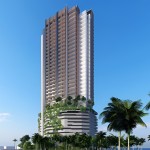
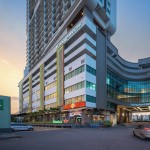
Eco World Development Group Bhd (EcoWorld) is expected to launch its first project in Penang, Eco Terraces condominium, in mid-June.

“Apart from being the first project for the group in the northern region, we believe Eco Terraces will also set new standards in high-rise living here,” EcoWorld president and CEO Datuk Chang Kim Wah said in a statement.

Eco Terraces will be located on Jalan Paya Terubong. The project should be about a 25-minute drive from Georgetown and approximately 15 minutes’ drive from the First Penang Bridge and Queensbay Mall. Eco Terraces is scheduled for completion in the second quarter of 2019 (2Q2019).

“For Eco Terraces, we have already started improving the infrastructure by upgrading part of Jalan Paya Terubong leading into the development,” said Chang.

The 12.79-acre freehold project offers 333 units in a 33-storey block. The units have a built-up area ranging from 1,095 sq ft to 2,008 sq ft. They come in layouts of 3-bedroom and 2-bathroom units and 4-bedroom and 3-bathroom units. Indicative prices are RM846 psf. Maintenance fee is estimated at 36 sen psf.

The gated condominium offers facilities such as a multipurpose hall, karaoke room, golf simulation room, indoor badminton or tennis courts, barbeque area, swimming and wading pool, gym, aqua gym, jogging and cycling tracks.

Chang added that the developer’s show gallery — EcoWorld Gallery @ Macalister along Jalan Anson — has a “3D walkthrough” experience of Eco Terraces to help visitors to understand what the condominium has to offer. The 3D walkthrough will run for a month from May 22.

Eco World said it has accumulated 5,245 acres of landbank, with RM65 billion worth of gross development value remaining.

Through the group’s associates, there are developments lined up for launch this year in Leamouth Peninsula, London (London City Island, GDV: £617 million [RM3.45 million]) and Parramatta, Sydney (Weat Village, GDV: A$285 million [RM802,641]). The former will be launched in Malaysia this weekend while the latter will be launched in 2H2015.

Source: TheEdgeProperty.com

Tags:

Penang Island vs Mainland (Part 4) – Population

Population

Population growth comprises two basic components – the natural population growth (birth and death), and the non-natural population growth (relocation), which by contrast may occurs quickly and unexpectedly.

With natural population growth, developers can react accordingly to the market demands. They are able offset anticipatable demand by providing more supply. On the other hand, a non-natural population growth may be unpredictable. Underreacting to that unexpected demand will drive up house prices.

So what does this mean for the property market in Penang?

Penang overall population has been growing steadily at around 2 percent per year for the past two decades and will continue to do so as the state has been going through a notable transformation. The figure below shows the population distribution between island and mainland for the year of 1991 and 2012 (latest available data).


FIGURE 1: Penang population distribution 1991 vs 2012


Clearly, the share of population living in the island has shrunk moderately over the years. By 2012, only 45.8 percent of the population lived in the island, compared to 48.7 percent in 1991. This is mainly attributed to the relocation of people from island to the mainland for cheaper houses and employment opportunities.

While the 2.9 percent population shift may seem insignificant, the dramatic change in growth patterns between 2008 and 2012 should not be overlooked (Figure 2). Most notably, the 4.9 percent average annual growth in southern part of Seberang Perai was the highest annual growth recorded among all districts since 2000. The trend is likely to sustain as the rapid economic development in Batu Kawan continues bringing enormous opportunities into the region.


FIGURE 2: Average annual population growth rate


With the extensive population growth channeling into the southern part of Seberang Perai, the quick demographic change will strongly influence the nature of demand for housing in the coming decades.

Perhaps the most debated question at present – Will Mainland ever be at the same level as the Island in terms of branding and property value? I don’t think anyone has a definite answer to this question. Instead, one should ask in response, “Why is it necessary to be the same?”

OTHER TOPICS:
Penang Island vs Mainland (Part 1) – Location branding
Penang Island vs Mainland (Part 2) – Land scarcity or abundant?
Penang Island vs Mainland (Part 3) – Connectivity & accessibility

– Ken Lim
(Founder and Principal Reviewer, PenangPropertyTalk.com)

Tags: