fbpx

Rising property prices – paper gains mean nothing

Property News/ 20 October 2015 No comments

By National House Buyers Association

In our article last month, we highlighted the report by Khazanah Research Institute on ‘Making Housing Affordable’, which showed that the Malaysian all-house price index grew steadily at a compounded annual growth rate (CAGR) of 3.1% from 2000 to 2009, and suddenly accelerated at a CAGR of 10.1% between 2009 and 2014.

Many existing property owners are overjoyed to see steep price increase in their properties compared to the cost of acquisition. These gains are referred to as ‘paper gains’ as the gains have yet to be realised and only exist on paper. However, we at the National House Buyers Association (HBA) are of the opinion that steep price escalations especially within a relative short span of time are not necessarily a good thing. For purpose of case study, we use the real life stories of some of our volunteers who were willing to share some data of their property purchase.

table-1

An overview of the type of properties bought by our volunteers together with their income levels and current property values are outlined in Table 1.

Based on Table 1, it would be reasonable to assume that Deepak, Ismail and Rachel should be happy with their ‘paper gains’, but looking at it deeper will reveal a very different situation.

Shrinking target market

In 2004, Deepak, Ismail and Rachel managed to buy their first home based solely on their salaries and the price was within the three-times annual income, which was considered as ‘affordable’.

However, just 10 years later and despite climbing up the corporate ladder, all three of them would find it ‘seriously unaffordable’ to ‘severely unaffordable’ to buy the same property based on their current salaries. This would also mean that other executive level wage earners to the senior management wage earners will also find it ‘unaffordable’ to buy the same property.

This will effectively mean that the target market for Deepak, Ismail and Rachel should they want to sell their current house has shrunk significantly. With a median annual household income of RM91,4402 in Kuala Lumpur for 2014, Rachel will discover that half of the population in Kuala Lumpur cannot afford to buy her modest apartment. Rachel can only hope to find joint-buyers in the middle management position with annual household income of at least RM166,667 to buy her apartment to be deemed as ‘affordable’.

The situation is equally bleak for Deepak and Ismail who could afford to buy their landed property just a decade ago whilst only in middle management position. Deepak and Ismail must also hope to find joint-buyers in senior management position with combined household income of at least RM183,333 and RM266,666, respectively, to buy their intermediate link house.

New purchase is also out of reach

We have ascertained that based on their current salaries, Deepak, Ismail and Rachel will find it ‘unaffordable’ to buy their current properties. This would mean if they want to acquire another property, they would have to dispose of their current property and hopefully, with the gains and cash from selling their current house, be able to afford something bigger and better.

The Household Income and Basic Amenities Survey 2014 by the Department of Statistics revealed that the Median Monthly Household Income for 2014 in Kuala Lumpur was RM7,620 or RM91,440 per annum.

The Household Income and Basic Amenities Survey 2014 by the Department of Statistics revealed that the Median Monthly Household Income for 2014 in Kuala Lumpur was RM7,620 or RM91,440 per annum.

However, based on our calculations in Table 2, even after disposing of their current properties, Deepak, Ismail and Rachel still cannot afford the ‘upgraded property’ that they desire.

From Table 2, we can see that back in 2004, the loan instalment was about 16% of their respective salaries. This is well within the range that Bank Negara’s ‘rule of thumb’ that the maximum single loan instalment is a third of the borrowers’ income and maximum combined loan instalment is half of the borrowers’ income.

From the above table, we find that despite disposing of their current property which has enjoyed steep gains, the new loan instalment as a percentage of their respective incomes is much higher than before, ranging from 43.47% to 55.07%. This would imply that to buy their upgraded property, buyers like Deepak, Ismail and Rachel will have to spend a larger chunk of their income and reduce on other spendings and possibly have no spare cash or savings to weather any sudden emergencies.

Increase in market value does not equate to increase in built quality or living quality

Without insulting any house buyer, a property that cost RM140,000 to buy from a developer will always be a “RM140,000 property”. Just because the market price has increased to RM500,000, it does not mean that the quality has suddenly improved, giving the new buyer a RM500,000 ‘built quality property’. This is the situation faced by many prospective house buyers; that the prevailing prices of properties, both existing and new properties offered by developers, do not reflect their built quality and living environment. Basic ‘bread and butter’ properties that were affordable for the lower- and medium-income earners just 10 years ago are now even unaffordable for the high-income earners.

As a result, many younger house buyers are willing to settle for smaller but cheaper units. Capitalising on this new trend, developers are building more smaller units that are actually studio-styled shoe-boxes with one or two bedrooms of no bigger than 650 sq ft, and priced them at around RM500,000 so that joint middle-income earners can afford it. But is it really worth paying so much for something so small? In the long run are such small units conducive for family living?

Is there a magic number?

Conventional wisdom has taught us that investing in properties is the best hedge against inflation in the long run. Many prospective house buyers want to invest in properties as a retirement fund or to fund their children’s education and hope that the returns from investing in properties are higher than merely keeping their money in the bank. Hence, every house buyer wants to see healthy appreciation in the value of their property.

However, when property prices escalate too fast within a short span of time, it can be harmful even to current owners, as shown above, when it is difficult for owners to sell their current property or upgrade to a larger property. Paper gains are only paper gains until the property is sold, but when your ‘bread and butter property’ is no longer affordable to half of the population, something has gone terribly wrong somewhere. Existing property owners cannot afford to upgrade their current properties and buy something ‘bigger and better’ and are stuck with their current homes. Clearly, such a situation does not benefit even existing property owners.

There is no real magic number per se on what is the acceptable or maximum annual increase in property prices. So long as the annual property increase is higher than the inflation rate and the rate of fixed deposits offered by banks, and still affordable to its intended target market, house buyers who buy for their own stay and for long term investment should be contented.

Source: StarProperty.my

Tags:

Asia Green to build residences overlooking Penang’s Pulau Jerejak

Property News/ 19 October 2015 5 comments

 Asian Green Properties Sdn Bhd Director Tan Li Mei. Photo by Shahrin Yahya (TheEdgeProperty.com)From its beginnings in plywood production and manufacturing, Penang developer Asia Green Group has become a diversified business entity with a fast-growing property development business.

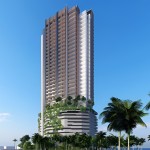
The group will launch its upcoming QuayWest Residence, a mixed-use development project with a gross development value of RM600 million, early next year.

Located just five minutes from Queensbay Mall at Persiaran Bayan Indah, QuayWest Residence will sit on 7.4 acres of commercial land with a sea frontage and a view of the 362ha Pulau Jerejak.

The development will have 1,235 freehold condominiums in two 24-storey towers, offering various unit types ranging from typical units and SoHos to duplexes and dual key units. There will also be some 253 affordable SoHo units available for first-time homebuyers.

Creative director Tan Li Mei, who is one of group managing director Tan Boon Huat’s daughters, talks to City & Country about the upcoming development and shares her ambitions for Asia Green.

“I am trying my best to bring out Asia Green Group in Penang, or at least rebrand ourselves and slowly venture beyond Penang,” she says.

From mostly boutique developments, she says the company is now ready to bring bigger developments to Penang with several projects in planning stages.

Source: TheEdgeProperty.com (Read more)

Tags:

New Measures to Ease Affordable Housing Application and Development

Property News/ 17 October 2015 5 comments

In an effort to improve the accessibility while stimulating the affordable housing development in Penang, the state government has introduced several new measures to ease the current market situation.

Increase in household income ceiling

With the hope that more applicants will be able to obtain bank loans, the household income ceiling for the application of affordable housing has been revised as below:

new-ahu-limit

New category of affordable housing

Taking into consideration those who earned RM6,000.00, the state government has also introduced a new category of affordable housing, namely units priced at RM150,000.00. These units are also sized at a minimum of 750 sq.ft., but without finishing (unlike the RM200,000.00 units).

Widen the pool of eligible buyers

In order to stimulate the sale of affordable housing units so that it is viable to be executed with at least 60% take up rate, it has been decided to enlarge the pool of eligible buyers to include those who already own a property. But the applicants must met the following criteria:

  • The property that he/she currently owned must not exceed the price of the affordable housing unit intended to be purchased.
  • The property currently owned has to be purchased after 2008.

30% of the affordable housing may be sold to the open market

In order to stimulate the development of affordable housing, it has also been decided that 30% of the units in any particular 100% affordable housing project may be sold to the open market, with the following condition:

  • The units are to be sold at 10% above the controlled price in South West, SPU, SPT and SPS districts.
  • The units are to be sold at 20% above the controlled price in North East district.
  • The purchaser has to be a registered voter in Penang
  • The purchaser can only purchase one such affordable housing unit
  • The said unit cannot be sold within 5 years from the date of vacant possession.

The developers for this new open market category will have to contribute to the Penang State Government the top up in price, not in cash but in kind, namely in actual affordable housing units in the said particular project, which will enable the State government to have its own affordable housing stock, which can be allocated to those who are on their list.

* Click here for a complete list of affordable housing in Penang *

Tags:

A retail paradise in the making

Property News/ 16 October 2015 1 comment

malls-sps

With three major shopping malls being planned for Seberang Prai, the mainland will soon rival the island as a shopping paradise.

The three malls are The Design Village (net lettable area (NLA) 400,000 sq ft), Ikea and Ikano Power Centre, and unnamed mall project by Belleview Goup (1.5 million sq ft).

PE Land executive director Joanna Ling said in an interview that The Design Village is positioned as a premium outlet and not a conventional mall.

“This is different from conventional malls, which offer groceries and general merchandise, targeting mostly families.

“The Design Village is a premium outlet mall, offering attractive discounts for premium and luxury fashion brand names,” she said.

Ling said the retail industry was evolving rapidly in a globalized economy where consumers demand instant gratification and sophistication but at fair value.

“This has resulted in the emergence of a new trend in retail in the form of premium outlet malls selling premium and luxury branded merchandise at a discount for off-season products that remain attractive to the broad market.

“This is why we have The Design Village in Penang. The Design Village will be the only premium outlet mall in Batu Kawan as the state has granted PE Land exclusivity for this retail concept,” Ling said.

She added that the estimated local catchment comprising residents and the working population of Batu Kawan itself, was projected to be around 250,000.

“This is in addition to the 5.5 million immediate catchment of the northern region, which includes Penang island,” Ling said.

Among the notable projects that are underway include the Eco World Premium Golf Resort, Columbia Hospital, Hull University, Aspen Vision City and the SME Village.

The Penang-based Belleview Group will soon launch its biggest commercial-cum-residential project to-date.

Its managing director, Datuk Sonny Ho, said the RM2.5bil mixed development project, to be located on a 8.09ha site, included the largest shopping mall in the northern region with 1.2 million sq ft built-up area.

“The mixed-development project will also include a four-star hotel, an Olympic-size skating rink, a 20-screen cineplex, and a high-rise residential lifestyle condominium component with 978 units,” Ho added.

The Ikea and Ikano Power Centre Mall to be located in Aspen Vision City in Batu Kawan from Aspen Group is scheduled to start soon.

Aspen Group chief executive officer Datuk M. Murly said earthworks for the Ikea store and the Ikano mall had started.

“The Ikea store, the first of its kind in the northern region, will be completed in 2018.

“The Ikano mall will have the best shopping, dining, and entertainment outlets,” he said.

Is Penang heading towards a glut in retail space?

On the island, there are eight shopping malls coming up over the next five years.

They are Penang Times Square Phase 3 (net lettable area 230,000 sq ft), City Mall Bayan City (300,000 sq ft), Southbay Plaza (424,000 sq ft), Penang World City (1 million sq ft), Sunshine Tower (2 million sq ft), The Light Water-front Mall (1 million) and Mall@Southbay City (750,000).

The new projects on the island and Seberang Prai will add over 7.6 million sq ft of fresh retail space to the market, which will worsen the glut in the local retail space.

The retail space per capita in Penang is 6.11 sq ft, while on the island it is 9.58 sq ft.

“The state has a lower per capita retail space than that of Klang Valley which stands at 7.35sq ft, while Iskandar Malaysia is 6.09sq ft.

“The retail space per capita should not exceed 5sq ft.

“Our opinion is that anything above that is oversupply,” Savills Malaysia managing director Allan Soo said.

Soo said as the competition toughens, malls will certainly need to have a pull factor such as a major difference in price, quality and uniqueness of the tenants and the merchandises.

“We also expect a lower rent regime soon where the mall operator works closely with the retailer and charges rent based on the tenant’s performance.

“The incentive is then for the operator to drive traffic into the mall instead of just waiting to raise rentals at each review period.

“This will differentiate the successful malls from the poor ones.

“The long-term prospects of shopping malls in Penang is moderate on average; albeit with some exceptions.

“Although the malls attract tourists from the region, the spectre of impending oversupply will raise the barrier for new entry malls,” he said.

Current retail space is 9.076 million sq ft from 20 malls, while the impending supply from 12 projects is over 7.4 million sq ft.

Current rentals for ground floor units at premier malls on the island ranges between RM17 and RM35.12 psf.

In the suburbs, the rental is RM24.62 psf for ground floor units.

On the mainland, the rentals for strategically located units in a premier mall starts from RM12.07 psf.

Henry Butcher Retail managing director Tan Hai Hsin said similar to Klang Valley and Johor Baru, oversupply of retail space in Penang had always been the last 10 years.

Tan said that this was evident from the fact that very popular shopping centres during the 1990s had been suffering from poor occupancy rates during the last 10 years.

“Rental rates of these shopping centres have not seen significant growth due to weak shopping traffic.

“They are unable to carry out major refurbishment due to multiple ownership.

“Abandoned shopping malls built during the 1990s remain the same during the last 10 years,“ Tan said.

On rental rates, Tan said popular and well-managed shopping centres such as Gurney Plaza, Queensbay Mall and several others would continue to enjoy healthy growth rates from year to year.

“At the same time, many strata-titled shopping centres will continue to suffer in low rental rates for years to come,” Tan added.

The long-term future for shopping malls is positive because Penang is the retail hub for the northern region, Tan said.

“Penang continues to attract international tourists due to its unique product offerings, while its economy continues to show good prospect in the near future.

“The second bridge has created a new growth area in the mainland, which will boost retail development in this area,” Tan said.

Meanwhile, Penang Institute fellow and head of urban studies Stuart Macdonald said new mall operations would face challenges in maintaining a sustainable business due to a stagnant population with strained purchasing power.

According to Macdonald, the total fertility rate for Penang in 2013 was 1.5, which is below 2.1, the healthy level for women to have children to replace themselves and their partner.

The 1.5 figure is projected to decline to 1.3 by 2040.

The total fertility rate is an important factor in determining population growth.

“The migration to Penang from other states has also dropped to 12,800 in 2014 from about 14,100 in 2013, the number of people leaving Penang for other states remains unchanged at 11,500 for 2013 and 2014.

“This has resulted in a net migration of 1,300 for 2014, which means that 1,300 stayed back in Penang after taking into consideration the difference between the immigrants and emigrants, compared to the net migration in 2013 which was 2,600.

From 1992-2013, the net migration for Penang was around 9,372 per annum.

“Without a strong population growth, it would be hard to imagine how the retail business in Penang could be sustainable,” he said.

Source: StarProperty.my

Taman Rupawan Emas

Kepala Batas/ 16 October 2015 3 comments

Taman-Rupawan-Emas-semi-d

Taman Rupawan Emas, a residential development by TAA Housing Development Sdn. Bhd. at Kepala Batas. It’s about 5 minutes drive to Sunshine Shopping Mall and the upcoming Tesco in Bertam.

This development comprises of a mix of 2-storey semi-detached bungalow houses, with indicative price starting from RM584,000 onward.

Project Name: Taman Rupawan Emas
Location : Kepala Batas
Property Type : Semi-detached and bungalow
Tenure : Freehold
Land Area: 2,244 sq.ft. onward
Built-up Size: 40 ft x 25 ft.
Total Units: 40 (semi-detached), 5 (bungalow)
Indicative Price: RM584,000 onward
Developer : TAA Housing Development Sdn. Bhd.
Developer : +6012-499 7795

Location Map:

Tags: