fbpx

Batu Kawan’s future potential

Property News/ 10 December 2016 2 comments

BatuKawantableBatu Kawan, Penang has been on the lips of property investors over the past few years ever since it was touted to be an emerging real estate hotspot in the northern region of Peninsular Malaysia.

Made up of over 6,000 acres of mainly freehold land, the area is located off Seberang Perai on Penang mainland. It used to be an oil palm plantation belonging to Batu Kawan Bhd (BKB) before the state government gazetted the land under the Land Acquisition Act 1960 in 1990. After a lengthy legal case, BKB was then awarded RM15,000 per acre from the initial RM8,167 per acre. BKB tried to raise the compensation to RM40,000 per acre but was denied by the Federal Court in 2001 on the grounds that RM15,000 per acre was sufficient for compensation.

In 2014, the Penang Development Corp (PDC) started developing Batu Kawan with the introduction of Bandar Cassia offering 11,800 units of affordable housing comprising 3,372 low-medium cost apartments and 8,428 medium-cost apartments to be built over 80.9ha. The first launch called Suria 1 was made up of 149 low medium-cost units of 800 sq ft priced from RM72,500, 98 Type-B medium-cost 900 sq ft units priced from RM168,000 and 273 Type-A medium-cost 1,000 sq ft units priced from RM220,000. The 520 units are said to be nearing completion and will be issued the Certificate of Completion and Compliance by June next year.

The 831-acre Batu Kawan Industrial Park (BKIP) was also promoted to attract high-technology and skill-intensive industries to the area.

According to associate director of Henry Butcher Malaysia for Seberang Perai Fook Tone Huat, Penang mainland, which constitutes more than two thirds of the size of the entire state, holds the future of the state’s growth.

“The mainland provides more opportunities for future developments than the island due to the scarcity of land on the island. Hence, the future of Penang would be focused on the mainland,” says Fook.

However, while Penang Island has seen rapid growth as a port and tourism city, only a few towns on the mainland, such as Butterworth, Simpang Ampat and Seberang Jaya, are considered business hubs. Hence the excitement over Batu Kawan as the next growth area.

“Batu Kawan is the upcoming growth area in Penang and in the northern region. It would be the new residential, commercial and industrial hub of the northern region,” Fook opines.

For CBRE WTW director Tony Lee Eng Kow, Penang mainland has been a hinterland to Penang Island with its industrial parks and residential neighbourhoods for the local working population.

“Batu Kawan is intended to be the third satellite town for Penang after Bayan Baru and Seberang Jaya, both of which are already fully developed. A number of integrated developments have been planned for Batu Kawan under the Batu Kawan Master Plan,” Lee says.

PA International Property Consultants (Penang) Sdn Bhd executive director Michael Loo shares that currently the main development hubs on Penang mainland are the old towns of Bukit Mertajam and Butterworth which have existed since the 1950s after World War II, and Seberang Jaya which is the first satellite township on Penang mainland developed since 1980 during the late Tun Lim Chong Eu’s tenure as the second Chief Minister of Penang.

“It took about 20 years to transform Seberang Jaya into a mature satellite township. Similarly, we foresee the development of Batu Kawan might follow a similar development model,” says Loo.

BatuKawan1Catalysts for Batu Kawan

According to Loo, Batu Kawan has the advantage of having vast parcels of flat land owned by the PDC, which allows for proper town planning and township developments. This makes it easier for it to be developed into a satellite city compared with the older towns such as Bukit Mertajam and Butterworth.

“The completion of the Second Penang Bridge in 2013, which connects the North-South Highway to Penang Island, was a notable infrastructure development that has eased accessibility and connectivity between the island and the mainland.

“The other notable development is the BKIP where several major MNC (multinational) industry players such as VAT Manufacturing Malaysia, Boon Siew Honda and Hewlett-Packard have set up factories and created job opportunities in the southern district of Seberang Perai,” offers Loo.

He also notes that PDC will be expanding BKIP to about 5,000 acres at the Byram and Changkat localities (southern part of Batu Kawan) and about 750 acres at Bukit Tambun (eastern portion of Batu Kawan).

BatuKawan2Significant developments

As for new property developments in Batu Kawan that are banking on its future potential, Loo cites Aspen Vision City by Aspen Group, One Auto Hub by PKT Logistic, Utropolis by Paramount Property, Design Village Mall and its surrounding projects by PE Land, IKEA furniture store and the upcoming developments by Eco World Development Group, including the 300-acre Eco Horizon and 75-acre Eco Sun township developments.

“The new developments will help position Batu Kawan as the next well-planned satellite township,” Loo adds.

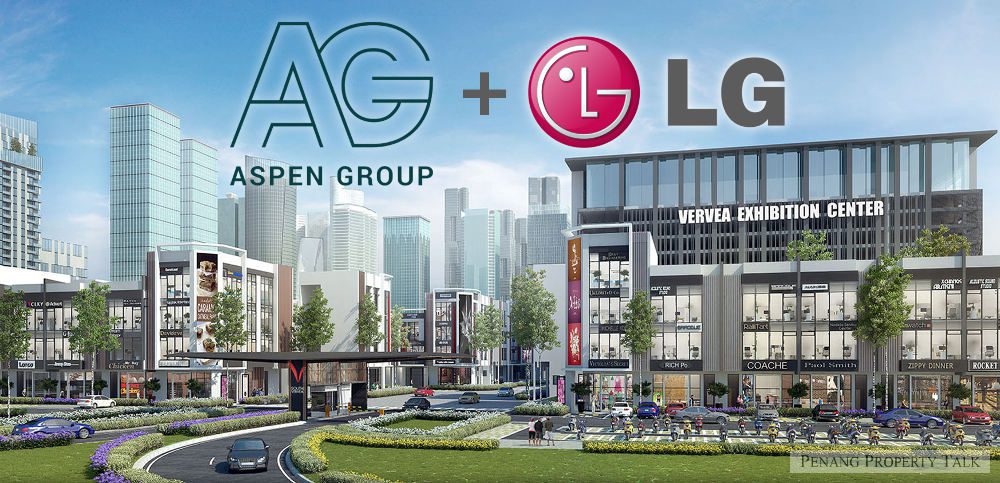
Mainland residents are certainly looking forward to the RM10 billion Aspen Vision City that will include the first IKEA furniture store in the northern region. Spanning 245 acres of freehold land, it is one of the largest mixed developments in Penang. It offers a combination of condominiums, shop-offices, serviced suites, hotels, office tower, financial hub, medical centre, international school and a range of amenities. The first phase of Aspen Vision City is the 35-acre Vervéa comprising 441 three- and four-storey shop-offices with built-ups ranging from 3,300 sq ft to 7,830 sq ft.

The second phase of Aspen Vision City is Vertu Resort, a resort-inspired condominium development with furnished move-in condition units. The project was soft-launched in February this year and is more than 60% booked. Aspen Vision City will also be seeing its first landed housing, a luxurious designer bungalow development called ViLuxe, being launched next year.

PE Land (Penang) Sdn Bhd also recently launched Design Village Penang on Nov 23. The first premium outlet mall in the northern state which boasts some 400,000 sq ft is part of the 40-acre mixed-used development that will include a hotel, serviced apartments and high-end condominiums.

Meanwhile, Paramount Corp Bhd’s property arm Paramount Property has recently unveiled the 44.3-acre Utropolis Batu Kawan university metropolis development with an estimated GDV of RM1.8 billion in Batu Kawan. It is the group’s first development in Penang and will feature residential, commercial, retail and hotel components as well as a new flagship campus for KDU Penang University College.

Beyond Batu Kawan, there are other significant developments including Pearl City by Tambun Indah Land Bhd, a 1,140-acre township in Simpang Ampat comprising landed properties, serviced residences, a commercial hub, international school and mall.

Current housing price trend in Batu Kawan

According to CBRE WTW’s Lee, as Batu Kawan grows, it is likely that there will be more high-rise developments as the earlier developments were mostly low-rise and landed in nature.

However, Henry Butcher’s Fook notes that the area has been seeing more high-rise apartments coming up as land prices have been rising. “Land price in 2006 was about RM10 psf. In 2016, it is about RM40-RM50 psf,” says Fook.

According to transaction data collated by TheEdgeProperty.com from the National Property Information Centre, terraced homes in Batu Kawan have seen their average price psf peak in 4Q2015 at RM204 psf, up 11.48% y-o-y. In terms of absolute average price, terraced homes in Batu Kawan recorded the highest transacted price of RM299,221 in 4Q2015, up 8.6% y-o-y. As at 2Q2016, the average transacted price was down by about 10% to RM175 psf (based on land area size).

According to PA International’s data, a single-storey terraced house in Taman Intan Chempaka with a land area of 1,249 sq ft and built-up area of 703 sq ft was transacted at RM170,000 in 2015, a 13.3% growth since 2013 while in Taman Intan Delima, a single-storey terraced house with a land area of 1,320 sq ft and a built-up area of 805 sq ft was transacted at RM280,000 in 2015, up 21.7% since 2013.

Meanwhle, a double-storey terraced house such as Callisia at Taman Crescentia with a land area of 1,475 sq ft and built-up area of 1,716 sq ft was transacted at RM400,000 in 2015, up 17.65% since 2013.

“The average price growth of existing housing in Batu Kawan from 2013 to 2015 was within the range of 10% to 20%,” offers Loo.

He also notes that the launch price of a new Vertu Resort condominium unit in Aspen Vision City is about the price of an existing double-storey terraced house.

“The upcoming projects will definitely have a positive impact on the pricing of the existing developments,” Henry Butcher’s Fook adds.

What lies ahead

According to PA’s Loo, the first phase of Aspen Vision City, which is expected to be completed by 2019, might be a vote of confidence to market players and homebuyers with the realisation and transformation of the oil palm plantations into a modern living satellite city.

“Besides infrastructure development, a vibrant growing population is one of the key factors in determining the sustainability of a township. The state government’s efforts to attract new industrial players to establish their plants in Batu Kawan and create more job opportunities would be crucial in achieving the desirable population number,” says Loo.

Nevertheless, it takes 10 to 20 years to establish a new mature satellite city. “The macro and micro economic environments will also determine the speed of the transformation,” he adds.

The experts contend that although in the short term, there may not be many choices for investment, the medium term will see more choices become available as developers begin their developments.

“I would advise investors to catch the earlier launches as prices are likely to be on the upward trend as newer developments come on stream and the place matures,” CBRE WTW’s Lee says.

Read More: TheEdgeProperty.com.my


Tags:

EcoWorld to launch new townships in Penang

Property News/ 8 December 2016 7 comments
eco-horizon

Upcoming project – Eco Horizon at Batu Kawan

Eco World Development Group Bhd (EcoWorld) is aiming for an even higher sales target for its 2017 and 2018 financial years after having met its sales target of RM4 billion in FY2016 ended Oct 31, 2016.

The developer recorded RM4.01 billion of sales in FY2016. Its Malaysian projects contributed RM3.402 billion while Eco World International’s (EWI) four projects contributed RM608 million, said EcoWorld CEO and president Datuk Chang Khim Wah at a press conference today.

Notably, the RM608 million sales is based on EcoWorld’s subscription for its 27% stake in EWI pursuant to the latter’s initial public offering in the first quarter of next year.

“In FY20017 and FY2018, we will be targeting RM4 billion of sales solely from Malaysia projects, while we expect to be entitled to a proportionate share of international sales by EWI based on our proposed 27% shareholding in EWI,” said Chang.

He expects EWI’s sales to be anchored by its existing four projects whereas the sales from Malaysia will be contributed by the existing 15 projects along with the proposed launch of two new projects: Eco Horizon in Penang Mainland and Eco Forest in Semenyih, Selangor.

Spanning 300 acres, Eco Horizon is a leasehold township development with an estimated gross development value (GDV) of about RM8 billion.

Eco Forest is another township project with a GDV of about RM3 billion. The freehold development spans 492 acres.

Both Eco Horizon and Eco Forest are poised to be launched by mid-2017, said Chang, adding that the developer is looking to enhance and improve the ongoing township developments in order to boost sales.

Read More: TheEdgeProperty.com.my


Tags:

Ensuring affordable homes for Penang folk

Property News/ 8 December 2016 1 comment

affordable-penang

As main cities in the country continue to urbanize, the provision of affordable homes remains a major concern. Penang is no exception.

Currently with a population of 1.66 million, Penang is one of the most populous states in the country and remains a highly desired location for property growth and investment. With half its population concentrated on the 293 sq km Penang Island, the state will only get more crowded as the Department of Statistics Malaysia has forecast the population to increase to 1.86 million by 2030.

To address population growth in Penang, the state government, through the Penang Development Corporation, has made the provision of affordable housing a priority, with the launch of its affordable housing scheme in February 2013. The scheme has 14 projects in all five districts in the state, with 26,255 affordable homes on offer.

“The state government is allocating RM500 million to provide affordable housing under this scheme,” state executive councillor for housing, town and country planning Jagdeep Singh Deo says in an email interview.

He notes that the state’s current household size of 3.98 will require an additional 22,613 homes by 2020 and another 27,638 by 2030.

At present, works under the affordable housing scheme have commenced for projects in Teluk Kumbar (Daerah Barat Daya), Kampung Jawa (Seberang Perai Utara) and Phase 1 of Bandar Cassia in Batu Kawan (Seberang Perai Selatan).

Phase 1 of Bandar Cassia, which has 520 homes, will be the first project to be completed in December this year. The entire Bandar Cassia development is slated to complete in the next 10 to 15 years.

The types of affordable housing range from Type A (formerly known as low cost) to Type B (low-medium cost) and Type C (units costing RM150,000 to RM300,000).

Types A and B units have a minimum floor size of 650 sq ft and are priced at RM42,000 and RM72,500 respectively. Type C homes come with a minimum floor size of 750 sq ft, and are capped at RM300,000 on the island and RM250,000 on the mainland.

Table3


To meet the projected 50,251 homes required by 2030, the state government has embarked on public-private partnerships. Private sector developers will contribute an equal number of affordable homes as the state government to ensure there are sufficient houses to cater for the growing population.

“With the introduction of the 100% affordable housing guidelines in August 2014, the participation of the private sector has been overwhelming. This clearly shows there is a large market for such a category of housing,” says Jagdeep.

* Complete list of affordable housing in Penang *

To date, the state government has approved applications by the private sector to build some 11,550 homes in accordance with the guidelines.

Ongoing affordable housing projects by the private sector are Tri-Pinnacle by Aspen Group, Ramah Pavilion by M Summit Group, One Foresta and I-Santorini by Ideal Property Group and Granito by BSG Group.

To encourage private sector participation, Jagdeep says the state government has agreed to reduce the compliance costs.

“The state has offered to waive the compliance component which requires 30% of homes built by the private sector to be priced less than RM72,500,” he adds.

“A reduction has also been offered on development charges. For regular housing developments, such charges are RM15 psf, whereas those stated in the guidelines are only RM5 psf,” he adds.

Jagdeep says the state government welcomes applications under the 1Malaysia People’s Housing ­(PR1MA) programme. PR1MA Corporation Malaysia had submitted several applications in December 2015 and three applications have been approved to date, namely for 2,387 homes in Tasek Gelugor, 905 in Bukit Gelugor and 1,450 in Batu Feringghi.

However, he adds that PR1MA has withdrawn its application to build 29 blocks of 23 to 27-storeys in Kuala Sungai Pinang, Balik Pulau, in April this year. The blocks consist of 9,904 housing units priced up to RM510,000.

Jagdeep says that PR1MA withdrew its application on the advice of the state government as Balik Pulau has a 16-storey height limit for buildings and under the guidelines, affordable units on the island have a price limit of not more than RM300,000.

“Just like all other applications for developments, the guidelines relating to affordable housing must be complied with,” he says.

“Nonetheless, the state government will duly process such applications expeditiously and hopes that PR1MA will continue to submit them for more affordable housing projects in Penang,” he adds.

To prevent applicants from abusing the affordable housing system, Jagdeep says the state government is consolidating the procedure to take legal action against those who rent out Type A and Type B homes, which are supposed to be owner-occupied. “We now require applicants to execute a statutory declaration that gives us the right to repossess the unit if it is rented out.”

Jagdeep, who also chairs the nine-member selection process enhancement committee, says the stringent vetting process will ensure only those who are truly eligible will be selected.

Besides submitting their central credit reference information system (CCRIS) record, applicants are also required to attend several sessions with the credit counselling and debt management agency (AKPK) to iron out issues related to housing loans.

Additionally, owners of Types A and B homes are not allowed to sell their properties for 10 years. Owners of Type C housing costing RM150,000 to RM300,000 ­cannot sell them for five years.

The state government is also addressing the problem of high loan rejection rates. “Getting a loan is the biggest hurdle,” Jagdeep says.

“For example, one of the projects in Bandar Cassia has 520 homes. We submitted 800 eligible names, but only 200 signed the sales and purchase agreement because the rest were unable to obtain a bank loan.

“Bank Negara Malaysia needs to address this problem. If we do not solve it, then the homes built will be a waste because the people are unable to buy them. As a result, Malaysians cannot fulfil their dreams of owning their first home,” he says.

Nonetheless, Jagdeep says the state government has discussed the problem with Bank Negara and stakeholders.

“The recent announcement of a reduction in bank loan interest is a positive step forward.”

“We hope this would result in more loans being approved, particularly for first-time home buyers.”

“The state government will continue to engage with Bank Negara to consider introducing better loan packages, for instance disbursing 100% loans; extending the repayment period, reintroducing the developer interest bearing scheme [DIBS] for first-time home buyers, and introducing accelerated and flexible tiered repayment,” he adds.

To assist developers participating in the 100% affordable housing scheme in the current soft economic environment, the state government has allowed 30% of the affordable housing units to be sold on the open market.

But the buyers must be Penang voters, and they are only allowed to purchase one unit.

“Thus, developers can achieve at least 60% sales. This in turn will ensure that eligible applicants have a roof over their heads,” Jagdeep says.

Read More: TheEdgeProperty.com.my


Tags:

Rainbow Skywalk set to open at Komtar

Property News/ 7 December 2016 1 comment

rainbow-skywalkOnly a lucky few have ever been to the top of Komtar since it was completed over three decades ago.

Now, 68 floors and at almost a quarter of a kilometre from the ground, it has the highest skywalk in the country.

The Rainbow Skywalk is a semi-circle glass path that juts several metres out of the building, and it is not for the faint-hearted.

“We’ve seen many people who cannot shake off that acrophobic dizziness when they step onto the glass. Some will not even try.

“But many love it. You can lie down and take a selfie with the little buildings below as your background. It is a rare opportunity,” said Only World Group (OWG) chief operating officer Datuk Jean Koh.

The glass was heat-treated, temper-proofed, laminated and is the same glass flooring used in America’s Grand Canyon Skywalk. Universiti Sains Malaysia ran a barrage of vibration, wind and pendulum tests on it.

From the ground, you can see the Rainbow Skywalk if you are standing near the junction of Penang Road, Macalister Road and Datuk Keramat Road.

The old roof used to be a helipad when the monolith was 65 floors. OWG topped it up with three more floors, did away with the helipad and transformed the roof into an attraction.

“Komtar is the pride of Penangites. It was once the tallest building in South-East Asia. When we first went up, the view took our breath away and we instantly started thinking of how we can get people to enjoy their trip to the top,” she said yesterday.

Video taken by Penang Property Talk in August 2016

OWG, a listed company that specialises in F&B and leisure attractions, won a 45-year lease on five levels of Komtar in 2012 and is on a mission to revitalise the building.

The company began with 5,574sq m in the complex and they are now using about 28,000sq m of floor space to turn Komtar into a leisure destination for Malaysians and tou­rists alike.

The official opening is on Dec 18, with many more delights being constructed on the roof, but OWG chief executive officer Datuk Seri Richard Koh is keeping the details secret.

“The best pleasures in the world have to be surprises. If I tell you everything, you will know what to expect when you get to the top.

“But, I will tell you that besides the skywalk, you will have the chance to sit on the luckiest chair in the world up there,” he added.

Read Source: TheStar.com.my

Tags:

23 Green Terraces @ Ghee Hiang Gardens (Phase 2)

23-green-terraces

23 Green Terraces, the second phase of Ghee Hiang Gardens at Greenlane, Penang. This is a freehold residential development by Six Eleven Assets Group, comprises 23 three-storey family homes with indicative price from RM2,988,000 onwards.

This development is less than 1km away from Udini roundabout, just a mere minutes drive to Central Park Condominium. Each unit comes with spacious built-up and balconies.

Phase 1: 27 Green Terraces @ Ghee Hiang Gardens

Property Project : 23 Green Terraces @ Ghee Hiang Gardens
Location : Gelugor, Penang
Property Type : 3-Storey Terrace
Tenure : Freehold
Land Area: 22′ x 88′ (Type A), 22′ x 92′ (Type B)
Total Units : 10 (Type A), 13 (Type B)
Indicative Price : RM2,988,000 onwards
Developer : Six Eleven Assets Group

Register your interest here

(This information will be used to keep you updated on the project and future development.)
*By submitting this Form, you hereby agree to our PDPA Consent Clause.

Location Map: