fbpx

Penang Hill to get better facilities soon

Property News/ 11 August 2011 No comments

Penang Hill and its surrounding localities will be upgraded at a cost of RM8.6mil as part of efforts to ease the traffic congestion there during the peak season and to provide a sheltered walkway for visitors.

Penang Hill Corporation (PHC) general manager Datuk Lee Kah Choon said it would be done in three phases.

The first phase comprises three projects while the other two phases are still in planning stages.

“The three projects are the building of shelters for the bottom and hilltop funicular railway stations and a walkway linking the bottom station to a neighbouring Chinese temple car park, which is under-utilised at the moment,” said Lee at a press conference on Tuesday.

The bottom station’s centre court will have shelters installed and it will also be done for the hilltop area.

A sheltered walkway will be built on the hilltop, leading to the promenade near the Bellevue Hotel.

“This will allow the visitors to take in the scenic view in a comfortable atmosphere. Currently, there are no proper shelters and it inconveniences the visitors, when it rains or when it is hot. The shelters will provide cover while at the same time provide an unobstructed view of the hill with proper ventilation,” said Lee.

“We will also build a sheltered walkway (less than 100m) linking the bottom station to a nearby temple car park. This means we will have more car park sites and two entrance points to the bottom station.”

This would ease the current traffic and crowd congestion, especially during the peak period, Lee said.

Penang Development Corporation’s consultancy head Khairil Faizi Abdul Majid said that the projects were expected to be completed within six months.

Tags:

Prai Tropika @ Perai Utama

Prai/ 10 August 2011 80 comments

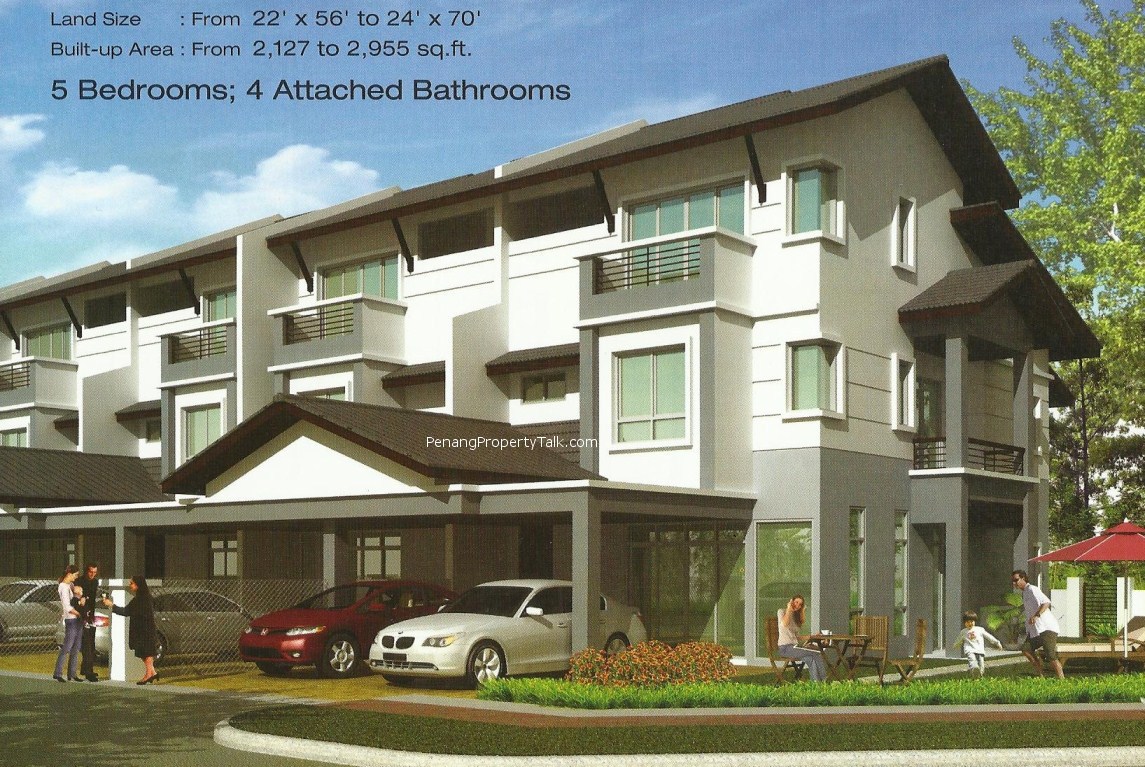
Prai Tropika is the latest residential development by Prima Prai Group located at the heart of Prai township in Penang. This development comprises 54 units of 2 1/2-storey terrace houses. Strategically positioned next to Giant Prima Prai and easily accessible via Butterworth Outer Ring Road (BORR) and North-South Highway. It is only 5 minutes away from Penang Bridge and mere minutes drive to Ferry Terminal.

Property Project : Prai Tropika @ Perai Utama
Location : Prai, Penang
Property Type : 2 1/2-Storey Terrace
Tenure : Freehold
Built-up Area: 2,127 sq.ft. onwards
Land Area: 22′ x 56′ onwards
Total Units : 54
Indicative Price: RM 374,000 onwards
Developer : Prima Prai Group
Contact No.: 04-389 2882 / 04-398 0033

Tags:

Mixed outlook for property in H2

Property News/ 8 August 2011 1 comment

PETALING JAYA: The outlook of the property market is mixed, with developers reporting firm sales while property agents report tell-tale signs of a slowdown in certain market segments.

Rahim & Co executive chairman Datuk Abdul Rahim Rahman said: “The market is giving a mixed indication, but what is happening in the United States and Europe is very serious and will have an effect on this part of the world. For example, the take-up rates of newly-launched condominiums have been very encouraging with more than 60% sold just a few months after launching. However, on the rental market, leasing has been less active and rental rate has not increased that much.”

“The quick and healthy take-up rates reported by developers mean that people are still confidently investing despite the seriousness of the US and European debt issues,” he said.

He expects the number of launches to continue to be fairly healthy with good take-up rates, especially for those outside the Kuala Lumpur city centre

“The market is not saturated. Although prices of landed units may have gone up quite a bit, it is possible to buy detached houses at RM1mil in Shah Alam,” he said.

Senior vice-president Gerard Kho of real estate consultancy Reapfield, reckoned that the market might be rather flat when compared with the first half of this year and the whole of last year. The market during the last 18 months have been exceptionally buoyant and the full impact of the US-Europe problems were not factored in by the market then.

“We are not sure what will happen in the second half of this year, but we are taking a cautious stand,” said Kho.

He said the prices of landed units would continue to go but they are seeing a disparity between asking price and transacted price widening. This disparity was seen a couple of months ago, he said. Prices have gone up compared with the first half of this year but the increase was less.

“We expect this situation to continue – growing disparity between asking and transacted price,” Kho said.

As for the condominium market, excluding the KLCC and Mont’ Kiara, prices have not gone down and rental remains strong. Kho said prices were flat in the Mont’Kiara and KLCC market.

The company was also seeing more listings coming into the market which means there were more units available now and buyers were waiting on the sidelines looking for a good buy, he said.

“But they are not going for fire-sale prices,” he said.

“People today will be buying at more realistic prices, unlike the first half of this year when they were prepared to pay more than the current market prices. As more stocks entering the market, the market may soften but despite that, high-rise units costing less than RM500,000 are expected to do well.

“If one is looking at the Klang Valley specifically, whether the market is up or down, there will be demand,” he said.

Kho said in terms of market activities, the first half of this year was the most buoyant compared with the Jan-June 2009 and Jan-June 2010 periods.

As for the healthy take-up rates, this may largely be attributed to the attractive lending terms offered by the banks together with the various rebates offered by developers.

In a 23-acre development known as Empire City next to the Lebuhraya Damansara-Puchong (LDP) by the Empire Group, a marketing agent reported that sales have been brisk with five to six units sold on a daily basis about two weeks ago.

Known as serviced office suites, the units are located on top of what will be a five-star hotel.

“This enables the buyer to apply for a 90% loan because this project is on a commercial title. If it were a residential title, he can only get 70% loan, if this is his third mortgage,” the agent said.

He explained that buyers need only pay a deposit of RM5,000. There is a 5% rebate. If a unit costs half a million, a buyer gets RM25,000 discount. He needs to pay the remaining 5% (RM25,000) upon signing the Sale and Purchase Agreement, less the RM5,000 booking fee. His initial capital outlay amounts to only RM20,000. The entire 23-acre development is expected to be completed by 2015.

Rebates have become a feature in today’s launches and may be a sign of the competitive property market, particularly for condominium sales.

In a three-acre development in Jalan Kiara 3, near Mont’Kiara heading towards Segambut, Mitrajaya Homes group relaunched Kiara 9 Residency over the weekend. The completed project comprises about 200 units of condominiums and 16 units of 3.5 storey villas. The condominium block is 70% sold, the villas, 50% sold.

There is a 20% rebate for condominium units facing west, those facing east, a 12% discount and those facing another upcoming condominium block, a 15% discount.

Some of the discounts could go as high as RM200,000. Landed villas come with a 5% rebate.

As an indication, a 2,200 sq ft unit complete with cabinet fixtures and electrical appliances on the 10th floor facing another ongoing block of high-rise apartment is priced at RM1.7mil, and a discount of up RM256,000 has been given.

Tags:

Blaring music driving ’em up the wall

Property News/ 8 August 2011 2 comments

RESIDENTS of two condominium blocks in Gurney Drive, Penang, are having sleepless nights due to the loud music coming from vehicles parked opposite their blocks.

One of the residents, who wished to be known only as Kori, 68, said he and his wife, Hashiko, 59, had not been sleeping well for the past five months because of the loud music.

“Every night, there will be cars parked opposite our block and loud music will be played from the speakers in the car boot. There will also be people dancing to the music ” it’s like a mini open-air discotheque for them.

“We’ve been living in this place since March and we thought it was a temporary thing at first but it has been getting worse especially on weekends,” said the Malaysia My Second Home Programme participant.

Kori, who hails from Osaka, Japan, said the music was so loud that he could hardly hear his wife speaking and they live on the third floor.

“We’ve made numerous police reports and even got our landlord to report the matter to the area’s assemblyman and it would stop for only a few days.”

Another resident, who wished to be known only as Teoh, said she too had difficulties falling asleep due to the loud noise.

Kori and Teoh said they had reported the matter to the building manage- ment and was told that they were in the midst of finding a solution to the problem.

The condominium?s property ma-nager Regan Maurice said the police had been alerted of the situation.

“There is a police beat base nearby but each time they see the police approa-ching, they’d quickly disperse but would come back again after the police had left.”

State police chief Deputy Comm Datuk Wira Ayub Yaakob when contacted said he would instruct his personnel to look into the matter.

SOURCE: The Star

Tags:

It’s time to spread development to underserved markets

Property News/ 6 August 2011 No comments

Given the sharp hike in housing prices in the hot markets of the Klang Valley and Penang island in the past two years, it is about time some long-term initiatives are implemented to promote the decentralisation and widening of our “core favourite markets” to the larger undeveloped peripherals.

Besides ensuring that development will be spread out to other parts of the country, these efforts will also be able to help “cool down” the hot property market.

Unlike some countries that face acute land shortage problem, Malaysia is blessed with vast tracts of land but the main problem causing the centralisation of development in the few core corridors can be traced to poor accessibility and lack of facilities of these undeveloped locations.

Fast-track development efforts such as extending the My Rapid Transit (MRT) system and promoting other urbanisation projects and activities to the outskirts will be a good start to spread out the development efforts.

I believe once such plans are in place and made known to the public, land owners and developers with land in these parts of the country will be encouraged to open up their land for development.

Unlocking the value of these land will be a worthwhile proposition to catch the wave of the seemingly insatiable demand of the housing market now. With the higher supply of good property projects, it will help to ease the market and prevent overheating like what has happened to some countries.

Developers looking to move into “blue ocean” or underserved market should make their move to lead in the affordable housing market by offering quality projects as they can be assured of a good following.

Malaysia is still a relatively young country and has a sizeable population of under the age of 40 years. Save for the 10% to 20% of the population who are in the wealthy and super-rich categories, most of the first-time home buyers will opt for medium-priced property.

I believe the local property landscape will need to go through major changes to keep up with the rapid urbanisation and rising housing and infrastructure needs of the maturing population.

And developers need to think out of the box and introduce more innovative building and design plans in their projects.

Some of the workable ideas include adopting minimalist housing designs to keep cost down and offering more flexibility to buyers to “dress up” their own property.

Available statistics show that many of the unsold residences in the KL City Centre (KLCC) area are highly luxurious and extravagant in their built-up (some up to 20,000 sq ft), which means their prices are also way above the affordability of the average Malaysians.

As such, projects that have yet to get off the ground can still be redesigned to allow for more smaller units of about 800 sq ft to 2,000 sq ft.

The condominium sector, particularly in the KLCC area, is still reeling from low take-up and occupancy rates.

In fact, a number of high-end projects witnessed a decline in both capital values and rents as the market consolidated after the heady growth of 2007-2009.

Of concern is the impending supply, with 2011 completions projected to be around 6,000 units, and we can expect this to have a further downside impact on the luxury residential market.

It is worth noting that despite the perceived wealth created by the sharp property price hike for property owners and investors, this will remain merely as “paper” gains unless the property have been transacted for cash.

Unless one is a serious investor and has a portfolio of property assets, those who can count the property they are currently occupying as their only asset will not be better off in monetary terms, unless they are counting the gains made on paper.

For many, the house or shoplot that they are occupying is the only asset that they own. There is no way they can realise the gain that comes with the higher price unless they are willing to liquidate their position by selling their unit and become a tenant.

But as we know, prices can go upwards and likewise they can take a dip when the market turns. So like the saying goes: It is wise not to count the chicks until the eggs are hatched.

For many average Malaysians who are dependent on their monthly wages to make ends meet and have yet to purchase their own home, they are the most hard hit by the property price hike. They are the ones who have little choice but to scour around for more affordably priced property to buy.

The various Government initiatives to set aside land for affordable projects is a good first step to a plan for more affordable projects for the average Malaysians.

Sizeable land parcels that are suitable for township development has become scarce and the Government’s pledge to set aside enough land to build medium-priced housing projects will hopefully be a long-term commitment to benefit the larger populace of the average folk.

Land is one of the main ingredients that have to be in place to ensure the success of the affordable housing programmes.

Development projects need planning and a gestation period from a few months to a year or two to materialise. By the time the two affordable housing programmes – My First Home Scheme and 1Malaysia Housing Programme – are able to deliver their first completed units to buyers, it will be at least two years down the road.

In the interim period, private developers have to take on the responsibility as the provider of these housing units and those who do will benefit in the long run.

SOURCE: The Star

Tags: