fbpx

Demographia: Malaysia’s residential housing market ‘severely unaffordable’

Property News/ 25 October 2014 No comments

When middle income professionals are unable to afford their own home based on a single income and have to team up with either a spouse or another person to qualify for a mortgage loan, then it is a sign that the unaffordability of our housing market has become critical.

A finding by US-based urban development researcher Demographia reveals Malaysia’s residential housing market is “severely unaffordable”, even more out of reach than residents in Singapore, Japan and the United States.

Demographia’s finding, cited by Singapore’s Straits Times in a report on Oct 14, rates housing as severely unffordable if the median of house price to annual income is 5.1 times.

Malaysia clocked in at 5.5 times, showing many Malaysians continue to be locked out of the housing market, compared with Singapore’s 5.1 times, while the United States’ and Japan’s housing markets were found to be “moderately unaffordable”.

Public interest group, National House Buyers Association (HBA) honorary secretary-general Chang Kim Loong says Demographia’s report supports HBA’s own finding that house prices, especially in the urban and sub-urban areas, have risen beyond the reach of many average Malaysians.

“For the past few years, HBA has sounded the alarm on the risk of a “homeless generation” made up of a growing number of young Malaysians especially the lower and middle income groups who are unable to afford their own home. When this homeless group grows in number, it can give rise to many other social problems,” he warns.

Siva: ‘The fact that salaries have not kept up with the upswing in property prices have further worsened … the situation.’
Chang says when even middle income professionals are unable to afford their own home based on a single income, the situation has become critical.

He says unless one is willing to be tied down by a long-term or back-breaking mortgage or mortgages, the high residential prices have rendered buying a house an increasingly uphill task, if not an impossible feat for the many lower income and average Malaysians.

“The skyrocketed prices have driven house buyers to take back breaking mortgages and many needed to combine their income in order to qualify for a mortgage, thus leaving them with very little or no savings after paying the monthly instalments and other basic necessities.

“This will place families at risk as they could fall into a deficit situation if any sudden emergencies happen to either of the borrowers,” Chang says.

He points out the possibility that in the event these borrowers cannot afford to pay their instalments and the banks are forced to auction off their properties, “there is a risk of a property bubble bursting, just like what happened during the sub-prime financial crisis in the US.”

“The borrowers and their dependents will also be faced with financial and emotional crisis that befalls their foreclosed property. Foreclosures can devastate a family’s economic and social standing, leaving them poorer instead,” Chang laments.

Chang says just six years ago it was still possible for a single middle level manager earning RM5,000 a month to buy a new double-storey link house in Kajang for less than RM250,000, and for a single executive earning RM3,000 a month to buy a new condominium in the Old Klang Road area for about RM200,000.

“Today, a new house in Kajang are in excess of RM700,000 but a middle level manager is just earning RM6,000 or thereabout a month. Recent launches of condominiums around Old Klang Road area are in excess of RM600,000, while the average salaries of executives are still around RM3,500 a month,” he laments.

He believes the maximum price that households with an monthly income of RM10,000 should purchase is only RM360,000 (RM120,000 x 3x).

“HBA has always stressed that affordable housing should be priced around RM150,000 to RM300,000, and not more then RM400,000 even for prime locations. Given that annual household income uses the assumption of two working spouses, there is a critical need for properties priced at RM150,000 to cater to single families and adults.

“We urge the government to further lower the threshold of affordable house price to between RM150,000 and RM300,000, and not more than RM400,00 even for prime locations,” Chang adds.

Chang says these houses, with minimum built-up of 800 sq ft and three bedrooms, need not come with fanciful finishing, but have just the bare necessities for a family’s comfort.

Stemming the greed

Malaysian Institute of Estate Agents (MIEA) president Siva Shanker concurs that the unaffordability housing issue has become critical over the past three to four years due to the sharp upswing in house prices.

“It was driven by the low entry costs with schemes such as no need for downpayment, developer interest bearing schemes and free stamp duty and legal fees, Although the Government has introduced various cooling measures and more responsible bank lending guidelines which has brought down the number of housing transactions, prices or value of houses still remain high.

“The fact that salaries have not kept up with the upswing in property prices have further worsened the unaffordability situation,” Siva explains.

HBA’s Chang points out the risks posed by “Investors’ Clubs” or “Millionaires Clubs” which are basically syndicated speculators incorporated by some ingenious individuals.

“They work in cahoot with developers, valuers and banks. Speculative buyers may be caught by the latest round of cooling measures. How the situation will pan out will depend on the holding capability of these speculators of which most of them may not have. Come hand-over time when it is time for these “investors” to flip their purchases, there may be a shortage of buyers for these properties, most of which were transacted at inflated and not real market value prices,” he warns.

Siva opines that the imposition of real property gains tax (RPGT) to tax gains from property transactions should be counted from the date of completion of the property and not from the signing of the sale and purchase agreement as what is being practised now.

This is given that it takes three years for high-rise residences to be delivered to buyers upon the signing of the sale and purchase agreement, and two years for landed property. Chang says the severity of the housing crisis for many Malaysians today calls for a workable housing delivery model to be put into action urgently before the problem spills over and cause more social problems in the country.

Housing the people has to be made the top thrust of the government and all possible measures need to be put to work fast and bottlenecks must be promptly addressed.

He says much more can be done to ensure a sustainable and orderly housing market for the people, stressing that holistic and concerted efforts need to be adopted.

“However, very often policies adopted are more for political expediency rather than for the betterment of the people.

“We need a single umbrella to monitor, regulate and police the performance of the various agencies that are entrusted with the role to ensure affordable housing index are met and properly distributed to the deserving ones. They must build the right quantity of the right property, at the right location, for the right populace, and at the right price.

“There must be full transparency on the location, number of units, registration and balloting process to ensure fairness to all eligible buyers,” Chang stresses.

A single database will enable individuals to learn about the availability of the affordable housing in their communities or in the communities they planned to move to, and understand financing options avail to them.

Siva also calls for a central planning and delivery agency to plan and coordinate all the affordable housing needs of the people.

“The whole process should be totally transparent with a master registry to record all the database of applicants and successful candidates. There should also be a moratorium period of up to 10 years to ensure that the successful candidates offered these affordable housing will not be able to dispose these homes for quick profit.

“The federal and state governments should provide the land and other forms of incentives to encourage private developers to lend their support for these affordable housing schemes,” Siva says.

Chang agrees that giving incentives to developers that build affordable housing will motivate them to throw in their support to build more of such housing units, adding that building up the infrastructure connectivity to the still relatively undeveloped areas will make these places more accessible and improve demand for property in those places.

“HBA has proposed to the government to take the lead by unlocking more of its vast land banks to build affordable housing for the people.

“The reason why developers are not chipping in to build more affordable housing units is because of the so-called profit maximisation by industry players. It is either high-rise multiple hundred units or high-end luxury units. Very often it is a combination of both – luxurious high-end units.I have not heard of developers building single-storey terrace houses that were so prevalent in the past. Developers are refusing to build such price and low margin items and will rather focus on higher margin items. With land being a scarce resource, developers will maximise the value of their land banks.

“If the land comes from the federal and state governments, private developers will be more willing to throw in their support to develop affordable housing for those in need,” Chang concludes.

Source: StarProperty.my

Tags:

Tips for consumers

Property News/ 25 October 2014 No comments

Oon presenting his talk on ‘GST: How does it Affect the Public and Property Investor?’ during the StarProperty.my Fair 2014 at Queensbay Mall, Penang.

Experts provide property fair visitors with useful knowledge

The fear that all products and services will be imposed with the goods and services tax (GST) by April 2015 is not justified, as not all businesses are eligible to collect GST.

TY Teoh International national tax director Richard Oon said only businesses with a turnover of more than RM500,000 per year would be able to charge GST.

“Businesses will have to display their GST licence in order to collect the tax. A receipt will also need to bear the GST identification number.

“Consumers can easily checked the authenticity of the receipt’s GST identification number by visiting http://gst.customs.gov.my.

“This means that consumers have a choice of buying products and services from a GST-registered company or a non-GST-registered company,” he said in Penang.

Oon was speaking at a talk on ‘GST: How Does it Affect the Public and Property Investor?’ at the StarProperty.my Fair 2014, organised by Star Publications (M) Bhd, with Zeon Properties as the event partner.

Oon added that there were six types of business that were not eligible to charge GST namely residential property developers, medical care companies, financial institutions, toll operators, transportation firms and insurance companies.

In a separate talk on Real Property Gains Tax (RPGT), Aljeffri Dean managing partner Neoh Chin Wah said the quantum of tax one would need to pay the Government depended on the category which the gain from the disposal of a property fell under.

“Make sure that you know which category you fall under before submitting the return to the Government.

“If the gain fell under the RPGT, depending on the period of disposal, it could be 0% if the property was disposed in the sixth year of purchase by an individual.

“If the seller is a company, and the property is dispose in the sixth year of purchase, the RPGT is 5%. But if the gain from the disposal of a property comes under income tax, the seller, if an individual, could be taxed up to 26%,” he said.

Prior to Jan 2014, the RPGT was 10%, if the property was disposed within the third to fifth year, and zero, if disposed after the sixth year.

Meanwhile, in a talk on ‘Dispel the Mystical Part of Feng Shui’, Malaysian Institute of Geomancy Sciences founder David Koh said any occurrence is mysterious if one does not know the scientific reason behind it.

“Feng shui is mysterious as it cannot be measured by any scientific instrument.

“Following more than 50 years of personal research, I conclude that everything which happens can be explained by science,” he said.

Source: StarProperty.my

Tags:

Affordable Housing Roadshow – Sunway Carnival (25 & 26 Oct)

Property News/ 23 October 2014 No comments

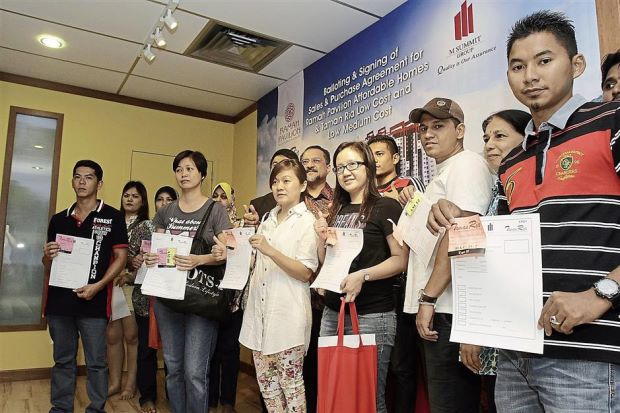
In conjunction with Northern Corridor’s Property & Investment Expo this weekend,  officers from the state housing department together with PDC will be going to Sunway Carnival Convention Centre in Seberang Jaya for the ‘Mission: Home-Possible’ road-show. It will showcase affordable housing projects, as well as assisting potential buyer to submit their completed application forms.

This is a two-days roadshow, open to public on 25 & 26 Oct (Saturday).

>> Full list of Affordable Housing in Penang <<

Tags:

Rehda: GST will push up home prices by 2.6%

Property News/ 22 October 2014 3 comments

Real Estate and Housing Developers' Association of Malaysia (Rehda) says the GST is likely to raise property prices.

Home prices will rise by about 2.6% once the goods and services tax (GST) comes into play, said the Real Estate and Housing Developers’ Association Malaysia (Rehda).

The chairman of the association’s task force on accounting and taxation, Datuk Ng Seing Liong, said that the calculation was based on its consultations with industry experts and member developers.

Rehda’s 2.6% estimate differs from that of the Customs Department, which expects the GST to have an impact of between 0.5% and 2% on house prices, assuming there’s no change in supply and demand conditions.

Ng said the association was in full support of the GST and concurred with Customs GST director Datuk Subromaniam Tholasy, who had said that land did not incur the 6% GST rate.

However, he said land was by no means the largest cost component in property development.

“As our calculation clearly spells out, the construction cost, which constitutes 46% of the total development, is not only the largest component but also the component which will attract the GST of 6%,” he said in a letter to StarBiz.

He said the GST on this component would inevitably lead to an increase in house prices.

Appending calculations for a housing unit originally priced at RM400,000, Ng said the price post-GST would be around RM410,560.

Under the 46% construction component, costs were broken down into non-service taxable and service taxable segments, representing 44%, or RM176,000, and 2%, or RM8,000, respectively.

Under the non-service taxable segment comes items such as cement/concrete, steel, bricks and sand, while the service taxable segment includes tiles and fittings/sanitary. Under the existing sales and service tax, no tax is imposed on the non-service taxable category, while the service taxable category has a tax of up to 10% imposed on it.

Post-GST, Rehda’s calculations showed that the non-service taxable cost had gone up to RM186,560, while the service taxable cost remained at RM8,000.

It maintained the same cost estimates for other items, including land (15% or RM60,000), infrastructure and pre-development works (10% or RM40,000), professional fees and marketing costs (6% or RM24,000), finance costs (6% or RM24,000) and profit (17% or RM68,000).

Ng said Rehda also disagreed with Subromaniam, who had said that developers could easily absorb cost increases as their margins were around 30%.

He said it was currently impossible for developers to earn up to a 30% profit, as most development costs were on the rise, along with various capital contributions and charges imposed on developers.

“On average, as tabulated in the calculation, developers, most of which are public-listed companies, are only making around 17% at best,” he said.

However, Ng said it was still too early to determine the actual house price increases post-GST, as Rehda was still in discussions with the Government and there appeared to be many more issues to be ironed out.

Source: StarProperty.my

Tags:

Smooth ride for road users

Property News/ 22 October 2014 9 comments

After a more than four-year delay, the third and final phase of the Tun Dr Lim Chong Eu Expressway will finally be opened to the public on Nov 1.

Jelutong MP Jeff Ooi said construction work on the project, known as the Jalan Tan Sri Teh Ewe Lim Extension, was already 95% complete.

“The 800m road costing RM70mil is borne by the developer, IJM. It will be open to traffic from midnight onwards on Nov 1.

Initially, it was scheduled to be opened in August, but there were several factors which delayed it.

“Firstly, it was Indah Water Konsortium in relocating the sewage pipes. Then the Mutiara Idaman apartment residents insisted on having an entrance and exit next to the road, despite it being objected by the Public Works Department.

“We settled the issue with the residents by retaining the entrance and exit. The developer will also install safety measures such as guard rails,” he told reporters before a walkabout to inspect the progress along the road in George Town yesterday.

Ooi said the large amount of utility lines at the squatter area along the road’s intersection with Jalan Jelutong also caused the project to be delayed.

“Work could only be carried out at night to move the utility lines due to busy Jalan Jelutong.”

He said the state government would also announce a new name for the road.

The extension is expected to help alleviate traffic congestion in Jalan Perak and Jalan Jelutong.

Source: StarProperty.my

Tags: