fbpx

Property to remain buoyant in 2011

Property News/ 16 December 2010 No comments

The property market in Malaysia is expected to remain buoyant next year, seeing a moderate uptrend in prices, in line with economic growth and growing interest among foreigners.

Speakers at a press conference on the Fourth Malaysian Property Summit 2011 here today said, no property bubble is expected in the foreseeable future, due to pent up demand for certain upmarket condo launches.

The Malaysian Property Summit is scheduled to be held on Jan 18, 2011 at the Sime Darby Convention Centre in Kuala Lumpur.

More than 200 participants, including developers, property owners, investors, bankers, financial analysts, economists, and property consultants are expected to attend.

Property consultant and valuer, James Wong said, the sharp increase in prices, is only to be seen in certain landed properties in choice locations with a huge demand for it in Kuala Lumpur and Penang.

James Wong is also the managing director of VPC Alliance (Malaysia) Sdn Bhd and regional chairman of VPC Asia Pacific Limited, a regional grouping of property consultants operating in eight countries.

"With escalating prices of property, one of the challenges for the government is to boost income, and move the country towards a high income economy," he said.

"This can be achieved by providing clear guidelines under the Economic Transformation Programme (ETP), especially on Private Finance Initiatives (PFI), as a majority of the funding under it comes from private initiatives," he told a press conference.

The president of the Association of Valuers, Property Managers, Estate Agents and Property Consultants in the Private Sector, Malaysia (PEPS), Choy Yue Kwong said in 2011, property prices would improve but the office market will remain soft.

"The property market currently is still very buoyant. Market prices are at record new highs. Interest rate is still relatively low," Choy said during the same press conference.

Choy emphasised that the high Asian savings will also cushion against a property bubble.

"It is challenging to own a house with a salary of just only RM4,000 a month. In 1975, a house in the Klang Valley was around RM30,000 and graduates earned about RM700 a month.

"Today, a graduate earns about RM2,000 but a house in the Klang Valley could easily cost RM400,000," he elaborated. Thus, Choy said, owning a house is only possible if the government made an effort to uplift income.

Eric Ooi, managing director of Knight Frank Malaysia, a global residential and commercial property consultancy, said this problem is prevalent in Asian countries.

"Funds and investment money is moving into Asia as the United States and the European economies are still struggling to come out of the doldrums.

"There is a lot of interest from buyers from China who are agressively buying into properties in Australia and Singapore. If these buyers start buying into Malaysian properties, then prices will further escalate," he said.

According to Ooi, there is a lot of interest at present from Singaporean and Hong Kong buyers, for Malaysian properties.
He highlighted that foreigners are looking at the yield in making decisions on property purchases.

"Currently, the Kuala Lumpur property market has a positive yield. Investors also like stability in the country and election results will have an impact on their investment mood," he explained.

He also said another factor to affect the property market is any increase in interest rates as it will impact the repayment of loans.

"However, there are expectations that the interest rate will not increase susbstantially," Choy added. — Bernama


SOURCE: Business Times
Tags:

Penang property a goldmine

Property News/ 15 December 2010 No comments

Property in Penang will continue to remain a favourite choice among investors as it is expected to show returns that are above the national average.

Henry Butcher Malaysia (Penang) Sdn Bhd director Dr Jason Teoh said property investment was generally perceived to have a longer term horizon as it was not so volatile compared to stocks.

He said investing in property had proven to be a good hedge against inflation because the returns ge-nerated were higher than the Con-sumer Price Index.

“In fact, seasoned real estate in-vestors from Hong Kong and Singa-pore have predicted that real value will increase over the next few years.

“Among the reasons is Malaysia’s recent positioning in the top 10 list of the world’s most competitive countries,” he said in a statement in conjunction with the official launch of the lifestyle suites, 118@Island Plaza, at level seven of Island Plaza, Penang, this weekend.

The public is invited to the sales gallery to view the show unit between 10am and 6pm on Satur-day and Sunday.

Response to the initial sales preview had been overwhelming with 50% of the 106 suites sold prior to the official launch.

Henry Butcher Malaysia (Penang) is the sole and exclusive marketing consultant for the contemporary suites owned by Omega Moments Sdn Bhd.

Teoh said foreign real estate investors had complimented Pe-nang’s progress in offering some of the most attractive product designs, but at prices which were only a fraction of those in their home countries.

“Penang’s real estate market can now be benchmarked against some of the best schemes in Kuala Lumpur and Singapore,” he said.

He added that Penang, being voted among the eighth most liveable cities in Asia, on par with KL and Bangkok by ECA International, had created further excitement, especially among foreigners seeking a second home.

118@Island Plaza is the first alteration and amendment development of its kind, which when completed, will offer much demanded housing and office units for professionals and expatriates.

Each unit, ranging from 500 sq ft to 1,160 sq ft, is thoughtfully conceptualised and designed as part of Island Plaza’s remodelling programme to bring in greater vi- brancy.

For enquiries, contact Henry Butcher Malaysia (Penang) Sdn Bhd at 04-2298999.


SOURCE: The Star

Tags:

BNM may increase interest rates in 2011

Property News/ 14 December 2010 No comments

A rise in consumer price index (CPI) may impel Bank Negara Malaysia (BNM) to resume increasing interest rates, by 25 basis points each in the second and third quarter of 2011, respectively.

The central bank, however, is expected to keep its monetary policy on hold in the first quarter of 2011 until there was more clarity on the global picture and given its "moderate inflation" projection through 2011.

"We are more concerned about CPI inflation, expecting it to rise to 3.3 per cent in 2011. This should impel BNM to resume raising rates, with 25 basis point hikes each in quarter two and three of 2011," Nomura Securities International Inc said in its 2011 Global Economic Outlook released here today.

Monetary conditions tightened in 2010 via real effective exchange rate appreciation and three 25 basis points rate hikes bringing the overnight policy rate to 2.75 per cent.

Monetary conditions should also tighten through further ringgit appreciation, given the large current account surplus and potential for larger capital inflows, said Nomura. "We do not expect Malaysia to impose controls on inflows in the near future," it added.

BNM recently further liberalised the capital account and set a 70 per cent loan-to-valuation ratio cap on third mortgages in a bid to curb property market speculation.

More macro-prudential measures are likely, it said. — Bernama


SOURCE: Business Times

Tags:

No woes from 5/95 home loans foreseen

Property News/ 14 December 2010 No comments

PETALING JAYA: As the timeframe for repayment of homes purchased under the 5/95 home loan scheme draws near, all eyes will be on the ability of buyers to repay their loans amid forecasts of a slowing economy next year.

A banking industry source estimated that 20% to 30% had started repayment and the bulk of repayment would come onstream next year. However, he said, most of these buyers were from the high-income segment and had traditionally been able to service multiple loans.

He said the scheme, currently for first and second homes, was for selected locations and was undertaken by a few top developers.

The scheme, he said, was extended during the recession two years ago and was likely to be stopped end of this month, as the contract between the banks and developers would be over and the property market picked up.

The 5/95 home loan scheme allows buyers to make only a 5% downpayment and sign the sale and purchase agreement.

Loans were secured by selected banks and the service of the loan only commence when the property is ready to be handed over to the purchaser.

The first property developer to introduce and implement the innovative 5/95 scheme was SP Setia in January 2009 in a cautious property market outlook.

The special home loan package was a great success and boosted the company’s second quarter revenue ended April 30.

Soon after, other established property developers such as Glomac Bhd, Mah Sing Group Bhd, Malton Bhd and Sunrise Bhd followed suit with their 5/95 home loan scheme, with minor variances and with varying degrees of success.

Since the 5/95 home loan scheme was implemented, the economic environment has changed. So how are the homebuyers of this scheme faring?

Real Estate and Housing Developers Association (Rehda) president Datuk Michael Yam said the special loan scheme was only adopted by selected and established property developers.

“The scheme was introduced mainly to affluent homebuyers, so Rehda does not foresee any repayment problems from these homebuyers presently or in the future,” Yam told StarBiz.

Moreover, he said, sales made from this special loan scheme would likely represent only about 5% of the total sales made by these developers from various property projects in 2009.

While growth in the developed world was expected to slow down next year, the local property market’s outlook was bullish, said Yam.

“Local banks are flushed with funds and we don’t foresee banks running into high levels of non-performing loans or default rate by homebuyers next year,” he added.

On the 70% loan financing cap for those wanting to buy a third residential property, Yam said it was mainly Bank Negara’s way of saying “we are monitoring the situation.”

A banking industry source said the special loan package in 2009 was structured in collaboration with several foreign and local banks as well as selected property developers.

“Interestingly, we find that homebuyers who had purchased several residential properties then under the 5/95 home loan scheme were less likely to be the ones who defaulted on their payments,” he said, adding that overall the late payments, or default rate, by these homebuyers were currently insignificant.

OSK Research head Chris Eng said that going forward, the local property market was seen to remain bullish despite an expected global economic contraction.

Eng concurred with Yam that local banks did not have liquidity problems.

“We expect the local property market to remain resilient at least for 2011,” Eng said.

On the default rates of homebuyers of the 5/95 home loan scheme, he said: “It’s a bit too early to tell as some of these homebuyers are likely to have either just started making repayments on their home loans or are about to.”

A spokesperson from SP Setia said that while the 5/95 home loan scheme introduced by the property developer was a great success, it was only for three months (from Jan 19 to April 19, 2009).

“We made good sales (from the promotion of the special home loan package) which helped to boost our company’s second-quarter revenue in 2009,” she said.

On the default rates of homebuyers under the special package, she said that so far it (default rate) was insignificant for homebuyers that had bought SP Setia homes completed in 2009.

“For homebuyers under the special scheme introduced in 2009, who are going to get the keys to their homes next year, we do not expect a high default rate on their home loan repayments,” she said.


SOURCE: The Star

Tags:

Tree Residency @ One Residence

Sungai Ara/ 14 December 2010 2,110 comments

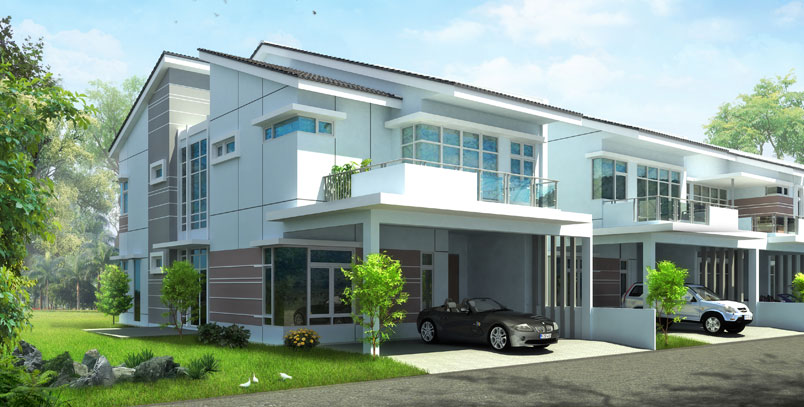
“Less is more” is the design philosophy of notable architect Ludwig Mies van de Rohe. With the Tree Residency, the values of minimalism are fully exuded, conveying a sense of harmony that comes from simplicity.

The minimalism in Tree Residency, however, is not one of emptiness, but one that is out of the box, with bold use of lines, geometry and ratio instead of fluff to achieve a clean and elegant look. More importantly, the materials used to construct Tree Residency are environmentally friendly, as such bringing its inhabitants close to nature.

The overall design of Tree Residency is skewed towards garden living, with eight different designs to suit the different requirements of buyers. The club facility of Tree Residency is complete with badminton court, half-sized Olympic pool and other recreational facilities that will bring out the athlete in you.

Location : One Residence, Sungai Ara, Penang
Property Type : Corner Duplex, Link Duplex, Twin Villa
Land Tenure : Freehold
Total Units: 316
Developer : Ideal Property


Contributed by reader (Update 27/2/13)

[nggallery id=41]


Contributed by reader (Update 24/6/13)

[nggallery id=53]


Contributed by reader (Update 25/8/13)

[nggallery id=59]


Contributed by reader (Update 18/9/13)

[nggallery id=60]

Tags: