Despite talk that the condo market on Penang island may experience slowing demand due to new supply and unsold units of previous launches, we highlight five developments that seem to prove otherwise.
RECENTLY the vivacious director of a public-listed company remarked that almost everyone she meets on the social circuit these days, is a “property developer”.
“It seems that everyone I bump into at a social event is calling themselves a developer,” said the immaculately-dressed boss of a property group, referring to those in the manufacturing sector and in the service industry.
Seemingly, anyone of any financial standing is jumping on the property bandwagon and coming up with boutique developments regardless of their experience or track record.
Her remark struck me as being profoundly true and indicative of another promising trend for the ambitious. But at the back of my mind, was the spectre of abandoned projects.
When I mentioned this remark to the CEO of an international property agency, he sheepishly admitted that he too, has a small share in a property venture.
His reckoning is that, with the pooling of resources with like-minded talent and with the right piece of land and concept, one really can’t go wrong. And looking at his project’s location, architectural concept and selling price, he may be on the right track.
Batu Ferringhi
And speaking of trends, Penang island continues to attract property buyers despite escalating prices, and consequently, more developments. Despite the fact that the Tanjung Tokong-Tanjung Bungah-Batu Ferringhi stretch of road is always congested with traffic during festive seasons, the north-eastern part of the island continues to attract holiday-makers and property investors.
In fact, the most expensive condo development on the island is on Batu Ferringhi beach, next to Hard Rock Hotel.
The By The Sea luxury development comprising 138 suites undertaken by SDB Properties (a subsidiary of Selangor Dredging Bhd) is commanding over RM1,400 psf for the sea-facing units. This residential development is SDB’s maiden project in Penang.
A lower-level unit which spans 107sq m (1,160sq ft) is available at RM1,723,000 or RM1,485 psf. But executive suites of 282 sq m (3,038sq ft) each, are available for RM3,489,000 or under RM1,200 psf.
The project is a commercial development and involves 1.9ha of freehold land.
Farquhar Road
The high price level of By The Sea may yet be topped by YTL Land & Development Bhd’s Shorefront condominium project. Soon to be launched, the latest word is that the premium units will top RM1,500 psf. This is also YTL’s first property development in Penang.
Sited next to the E&O Hotel along Farquhar Road in George Town, the initial proposal of 75 duplex units on six storeys, is being revised right now.
Originally, the plan was to have low-rise condominium units of between 345sq m and 380sq m (3,720sq ft to 4,100sq ft) — with only two units on each floor.
Word has it that some of the 380sq m units will likely be halved to become smaller units. But overall, the total number of units will stay below 100 to maintain exclusivity.
At present, the indicative selling price is between RM1,200 and RM1,500 psf. What’s most attractive about this development is the location. The 1.2ha of freehold land next to the sea is one of the best spots in the city.
Weld Quay
Also, located in George Town is another interesting high-priced development that capitalises on Penang’s colonial architecture. While the larger residential units are selling about RM1,250 psf, the smallest units surprisingly even exceed RM1,400 psf.
Located in Weld Quay, within the Unesco World Heritage site in George Town, the RM250mil Rice Miller mixed-development project offers another luxury living option. This development — in the old harbour area — is said to be modelled after other waterfront developments such as in Boston, New York, Baltimore, London and Sydney.
Undertaken by Asian Global Business Sdn Bhd (AGB), the development is sited on four adjoining parcels of freehold land totalling 1.2ha.
Spearheaded by AGB chairman Kate Lim and managing director Dr Noraini Abdullah, this maiden property development includes a serviced-residence component plus a boutique hotel with 48 suites, two office buildings, retail space as well as food and beverage outlets. The concept is colonial architecture with modern amenities.
Lim is the great-granddaughter of Lim Choo Guan (1884-1901), who is better known as Phuah Hin Leong, a pioneering and wealthy rice miller in Penang. Puah was also the grandfather of former ambassador and illustrious lawyer Tan Sri P.G. Lim.
Touted as low-density, the Rice Miller City Residences will comprise 99 serviced residences within two residential blocks of five-storey height.
With 16 layout designs, the units range from studio homes to one-bedroom, two-bedroom and three-bedroom units as well as duplexes. The built-up areas range between 71sq m and 322sq m (766sq ft and 3,472sq ft). The units are priced between RM1.13mil and RM3.7mil.
When opened, the Rice Miller Hotel will reportedly charge RM1,000 a night for its luxury suites of 51sq m (550sq ft).
Tanjong Tokong
Meanwhile, Eastern & Oriental Bhd (E&O) has been in the news quite a bit recently. Property-wise, the company has just launched its Andaman at Quayside condominium project in Seri Tanjung Pinang, Tanjong Tokong, at an average price of RM1,200 psf.
However, only Tower 1F of the three residential tower blocks is open for sale. There will be a second launch in July. Other phases will eventually include four more residential towers.
Located within the 8.5ha Quayside resort development, Andaman at Quayside takes up 2.6ha of the freehold land and is near a marina at Straits Quay. The architectural firm for the project is GDP Architects.
Among the unique attractions at the Quayside development is a 1.8ha private waterpark designed by Seattle-based landscape architects at Geyer Coburn Hutchins.
From the how units, its seems that the,two-bedroom Type D (190sq m / 2,046sq ft) layout offers a more luxurious feel, especially with the two equally spacious bathrooms. And the extra large balcony is a bonus.
The other layout options include two types of one-bedroom suites (85sq m and 105sq m / 914sq ft and 1,127sq ft) and another one-plus-one bedroom unit as well as two types of three-bedroom suites (258sq m and 262sq m / 2,776sq ft and 2,824sq ft).
Batu Maung
For more affordable condos, we have to look further afield. On another part of the island, in Batu Maung, is Mah Sing’s Southbay Development. The site spans 35.6 ha (88 acres) of freehold land and comprises three main components:
Southbay City (on 14ha, the commercial and tourism component will include residential suites, mall, Grade A office units, hotel and resort);
Legenda @ Southbay (on 11.2ha, there will be 76 resort bungalow units of three- and four-storey height. Built-ups are from 600sq m or 6,460sq ft); and
Residence @ Southbay (on 10.4ha, a total of 284 super-linked houses of three-storey height have been built and sold. Built-up is from 290sq m or 3,130sq ft).
Within Southbay City, the Southbay Plaza project is one of the eight parcels of development and comprises retail outlets and residential suites, which have yet to be launched. It is now open for preview for early birds. The residential suites offer a total of 206 units, while the retail outlets number 47 units. The average cost is RM568 psf.
38 projects
Of late, Mah Sing has been phenomenally active. To date, the Mah Sing Group is involved in 38 property developments. It has completed six projects and is currently selling 16 projects while working on launching 11 more. Five more projects are in the planning stages.
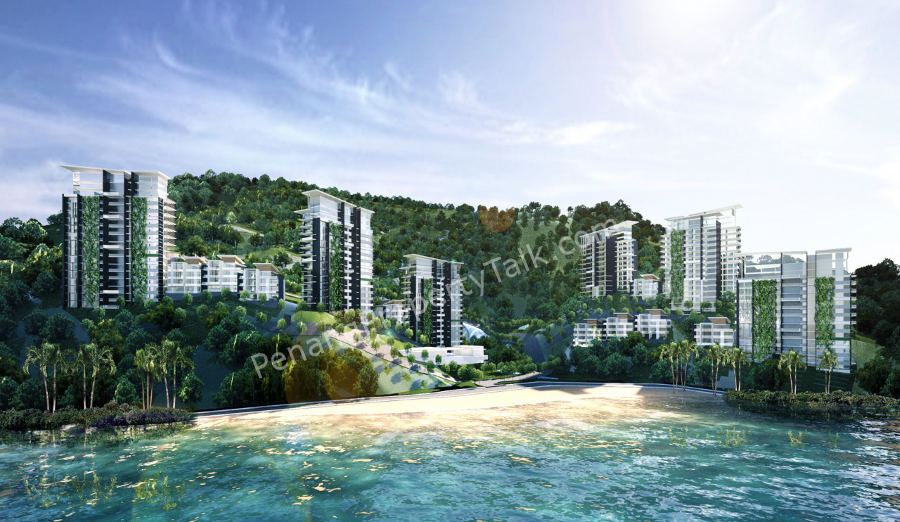
Besides, the Southbay projects mentioned earlier, its Penang developments include Icon Residence and Ferringhi Residence. The latter involves low-rise condo villas and high-rise resort condominiums. The Ferringhi site is accessed via Jalan Sungai 1 (opposite the Parkroyal Hotel) off Jalan Batu Ferringhi.
Located at Pykett Avenue in George Town, Icon Residence involves 1.3ha and offers waterfront living. There are four condo towers between 24 and 30 storeys. There are six layout options ranging from 120sq m to 325sq m (1,300sq ft to 3,500sq ft) at an average cost of RM700 psf.
But it is in the Klang Valley, where Mah Sing has been most visible. Its latest projects include:
M City, Jalan Ampang, KL (Phase 1, 401 SoHo units at RM919 psf have sold out. Phase 2, 546 serviced apartments at RM1,080 psf have sold 40%);
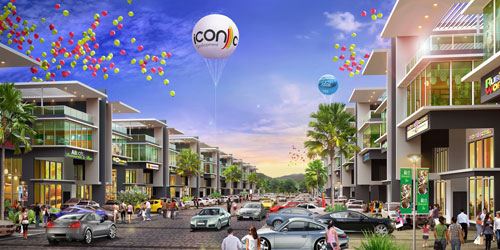
Icon City, PJ (The Icon Residence will be launched in May. The 249 units of the residential tower will have an average price of RM830 psf. And the Central Park and Gourmet Street shops totalling 20 units will sell for RM1,200 psf this weekend);
Ambrosia @ Kinrara Residence, Puchong (a new launch of 79 executive bungalows of 521sq m [5,608sq ft]. Prices from RM2.93mil with an average of RM486 psf);
M Residence, Rawang (a new launch of 6.7m by 23m [22ft x 80ft] double-storey, linked houses with a built-up of 221sq m [2,380sq ft]. Total of 165 units with 75% sold. Average cost is RM241 psf);
Icon Residence, Mont’ Kiara, KL (residential tower with 260 serviced apartments costing between RM1,200 and RM1,300 psf. Some 40% has been sold); and
Aman Square 2 @ Aman Perdana, Klang (two- and three-storey shops and office suites).
So, if you are keen on the property industry and looking for new job opportunities, Mah Sing is one company that is definitely going somewhere — fast.
Source: The Star

 PETALING JAYA: Overall price appreciation for residential properties is expected to range between 5% and 10% this year, according to CIMB Research.