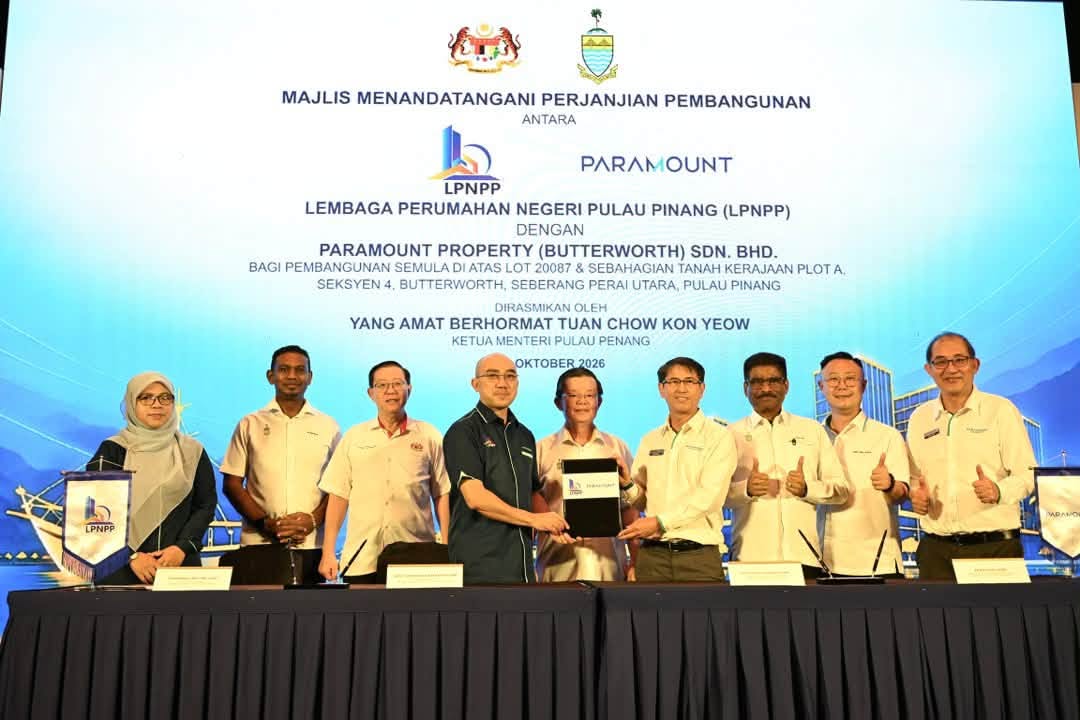
Penang is gearing up for a major digital upgrade—this time in the world of land administration. The state officially signed its Public-Private Partnership (PPP) concession agreement for the new e-Tanah system today at the Islamic Arts Museum in Kuala Lumpur, marking a big leap forward in how land matters will be handled in the future.
Chief Minister Chow Kon Yeow, who witnessed the signing, called the moment a turning point for Penang’s digital ambitions under the Penang2030 vision.
“This agreement is not just a contract—it’s a catalyst,” he said. “We want a system that’s fast, secure, efficient, and truly people-centric.”
And Penang definitely needs one. With massive reclamation projects like Andaman Island and Silicon Island Phase 1 in the pipeline—together boasting over RM100 billion in gross development value—the state expects land-related transactions to surge from 15,000 cases a year to as many as 30,000 in the coming decade. Everything from land transfers and leases to strata titles and Exco approvals is set to rise sharply.
The current e-Tanah system, introduced back in 2008, has been showing its age for years. Even with RM8.3 million poured into maintenance and upgrades, users still face sluggish processes, limited features, and recurring inefficiencies. A fresh, modern, fully integrated system isn’t just nice to have anymore—it’s essential.
Thanks to support from the Federal Government, including NRES, JKPTG, UKAS and the Prime Minister’s Department, the next-generation platform will now move ahead under a 14-year concession with Puncak Tegap Sdn. Bhd., developed through the Private Finance Initiative (PFI). Chow also expressed appreciation to Prime Minister Datuk Seri Anwar Ibrahim for backing the effort.
The Federal Government, represented at the event by Plantation and Commodities Minister Datuk Seri Johari Abdul Ghani, lauded the project as a strong example of collaboration between federal agencies, state authorities, and the private sector. Johari stressed that efficient land governance is the backbone of economic development and smoother public service delivery.
The good news is that Penang is already building momentum. Since launching the PgLAND system in 2023, the state has seen usage jump by an impressive 73%—from 103,000 users to 178,860 in 2025. PgLAND currently handles digital title transfers, registrations, and land searches, and the plan is for the new e-Tanah platform to integrate seamlessly with it.
“We want PgLAND to eventually become a fully efficient platform for land and parcel tax collection,” Chow said. “Integration with e-Tanah will strengthen Penang’s overall digital delivery ecosystem.”
If everything goes according to plan, Penang should have a fully functional next-gen e-Tanah system by 2027—right on track with the state’s push toward smarter, faster, and more transparent digital governance.