fbpx

Penang’s Roadmap to 2040: Growth, Mobility and Liveability in Focus

Property News/ 18 August 2026 No comments

RSNPP2040-1

The draft Penang Structure Plan 2040 (Review) has been positioned as a long-term development framework to guide the state’s growth over the next 15 years, with an emphasis on balancing economic development, infrastructure, housing, mobility and environmental sustainability.

Chief Minister Chow Kon Yeow said the draft should serve as a “compass” for Penang’s development, while public participation would allow residents and stakeholders to help shape the state’s future direction. He said development planning should not be viewed solely as the responsibility of the state government, but as a shared process involving residents, industry players, professional bodies, academics and other stakeholders.

rsnpp2040-5

The draft replaces the Penang Structure Plan 2030, which was gazetted on Oct 24, 2019, in accordance with the Town and Country Planning Act 1976 (Act 172).

Chow said Penang had undergone rapid growth as a major economic, industrial and technology hub over the past several years. However, this growth had also brought more complex challenges, including climate change, flooding, pressure on land and water resources, the need for affordable housing, rising living costs, mobility issues and changes brought about by technology and the digital economy.

Among the key priorities identified in the draft are achieving a better balance between development on Penang Island and Seberang Perai, optimising land use, strengthening growth centres, promoting transit-oriented development, improving transport connectivity, addressing housing needs, enhancing economic competitiveness and protecting the environment.

Chow also said major developments such as Silicon Island should be assessed comprehensively, taking into consideration their potential impact on economic growth, infrastructure, employment, housing, mobility and environmental sustainability.

He stressed that the draft is not yet finalised and remains open to feedback and proposals from government departments and agencies, local authorities, the private sector, academic institutions, professional bodies, NGOs and local communities. Public feedback will be reviewed and considered before the document proceeds through the approval and gazettement process.

On the proposed third bridge or tunnel, Chow said the project remains an indicative future development. Its implementation would depend on the existing agreement and relevant development schedules. He noted that some development zones in the draft are also indicative, with their eventual implementation depending on government decisions or private-sector plans for land development.

Meanwhile, development on Pulau Jerejak will be limited to 80 acres of privately owned land. The remaining areas will continue to be zoned as permanent forest reserves. While utility and infrastructure projects may still be considered within the forest reserve, other forms of development will not be permitted.

The public participation programme is intended to gather views before the draft is finalised, with the state government emphasising the need for future development to remain balanced, sustainable and liveable.

Tags:

Penang property market shows resilience amid selective demand in 1H2026

Property News/ 17 August 2026 No comments

penang-skyline

Penang’s property market remained relatively resilient in the first half of 2026, although market activity was more measured as buyers and investors became increasingly selective. According to Knight Frank Malaysia’s Real Estate Highlights 1H2026, the state’s established manufacturing base, continued investment, infrastructure development and tourism activity provided support to the property sector, while affordability, location and product quality remained important considerations.

The residential market was softer in 1Q2026, with transaction volume declining 16.6% year-on-year (y-o-y) to 3,443 units, while transaction value fell 13.2% to RM1.6 billion. Demand remained concentrated in the affordable and mid-priced segments, particularly properties priced between RM200,000 and RM400,000. Despite the lower transaction activity, residential values remained resilient. The Penang High-Rise Residential Price Index rose 3.4% y-o-y to 229.9 points.

High-rise residential supply also continued to expand, reaching 138,330 existing units in 1Q2026, up 6.9% y-o-y. Nevertheless, developers remained active, with approximately 1,998 residential units launched in 1H2026. Serviced apartments accounted for most of the new launches, alongside premium, low-density condominiums. Notable launches included AVEA in Andaman Island, The Fount in Batu Uban, Keeperz Suites and Merione Residences in The Light City, with gross selling prices ranging from about RM840 to RM1,857 per sq ft among these projects.

The industrial sector continued to stand out as a key growth driver. Penang recorded RM4.9 billion in approved manufacturing investments in 1Q2026, including RM3.4 billion in foreign direct investment. Industrial transaction volume and value also increased by 19% and 67.8% y-o-y respectively, reflecting continued demand for higher-value industrial assets. Major investment announcements during the period included Nexperia’s RM1.6 billion semiconductor investment, WaferWise Semiconductor’s RM700 million investment and Boston Scientific’s RM308 million project in Batu Kawan.

Penang’s office market expanded modestly following the completion of The Light Exchange in Gelugor, which added about 176,000 sq ft of net lettable area. Total privately owned office stock increased to approximately 8.2 million sq ft, comprising 6.7 million sq ft on Penang Island and 1.5 million sq ft in Seberang Perai. Occupancy continued to strengthen, supported by demand from global business services, technology and corporate occupiers.

The retail market remained relatively stable, with cumulative supply at approximately 21.1 million sq ft and an overall occupancy rate of 70.5%. The upcoming 1 million sq ft The Waterfront Shoppes is expected to introduce additional competition while benefiting from tourism and MICE-related activity.

Meanwhile, Penang’s hospitality sector continued to strengthen, supported by tourism activity, improving air connectivity and a growing MICE sector. The state has an active pipeline of 18 hotels, while recent openings have expanded its offerings across luxury, heritage and lifestyle segments. However, increasing hotel supply has also resulted in greater competition, particularly in the four-star segment.

Looking ahead, Knight Frank expects Penang’s high-rise residential market to remain relatively stable, supported by the state’s economic base, urbanisation and demand for well-connected locations. Major infrastructure initiatives, particularly the Mutiara LRT Line and Penang Silicon Island, are expected to enhance connectivity and support selected residential locations. At the same time, buyers are likely to remain cautious and place greater emphasis on affordability, practicality, connectivity and long-term value.

Penang to ban new worker accommodations in residential areas from Sept 1

dom

Penang will no longer allow new worker accommodation facilities in residential areas from Sept 1, as the state introduces tighter guidelines aimed at gradually shifting from Temporary Labour Quarters (TLQ) towards Centralised Labour Quarters (CLQ).

Local government and town and country planning committee chairman Jason H’ng Mooi Lye said the new guidelines would limit worker accommodation to commercial and industrial areas. TLQ permits issued under the 2024 guidelines will remain valid for three years and expire on Dec 31, 2027.

Existing worker accommodation facilities in residential areas will be reviewed if operators apply to continue their operations. The review will take into account factors including complaints received, with H’ng citing long-standing premises such as those in Taman Pelangi near Juru as examples.

Penang currently has 1,617 permitted TLQs under the Penang Island City Council (MBPP) and another 1,492 under the Seberang Perai City Council (MBSP). In comparison, the state currently has only two CLQs under MBPP and four under MBSP.

The new guidelines also introduce minimum space and toilet requirements. Dormitories must provide at least 3 sq m of space per worker, with one toilet for every 15 workers. For high-rise buildings, the minimum is 3.6 sq m per worker, with one toilet for every six workers.

Application fees are set at RM1,500 per unit for accommodation measuring 750 sq ft or below, and RM3,500 per unit for units measuring 751 sq ft and above.

Operators must first obtain a permit from the relevant local authority before applying for a Certificate of Accommodation from the Penang Labour Department.

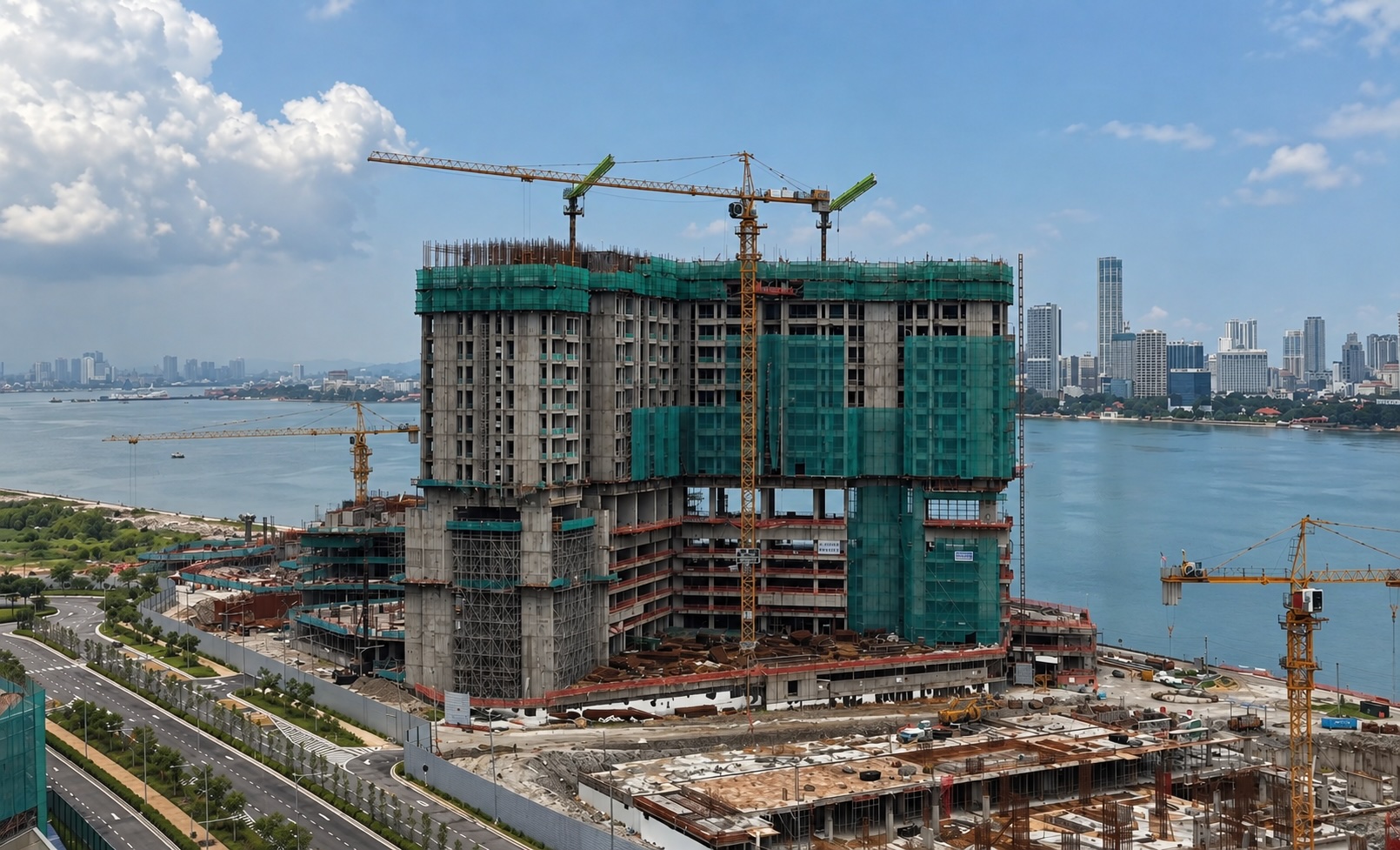
SITE PROGRESS: Mandarin Residence (Aug 2026)

Property News/ 16 August 2026 1 comment

mandarin-residence-site-progress-aug-2026

About Mandarin Residence

Affordable housing project by Focal Products Sdn. Bhd. in Farlim, at the junction of Jalan Teochew Satu and Jalan Thean Teik. It is right next to Hui Aun Apartment and just 1km from Sunshine Central. The development features a total of 646 residential units with 11 levels of car parking podium. With direct access to Thean Teik Highway, residents enjoy excellent connectivity and nearby conveniences.

Find out more about Mandarin Residence

Register your interest here to keep yourself updated with future development

(This information will be used to keep you updated on the project and future development.)
*By submitting this Form, you hereby agree to our PDPA Consent Clause.

Penang Gateway reclamation concept included in Penang Structure Plan 2040

Property News/ 15 August 2026 No comments
batu-ferringhi-penang-gateway

Source: Final Draf RSNPP2040

A proposed “Penang Gateway” development along Penang Island’s northern coastline has emerged as one of the potential future development concepts identified in the draft Penang Structure Plan 2040.

The proposed concept involves reclamation and mixed development extending from Tanjung Bungah to Batu Ferringhi, with potential uses including tourism, services, trade and property development. Chief Minister Chow Kon Yeow confirmed that the state government has received a proposal related to the area, but stressed that it remains only a proposal at this stage.

Speaking after the “R.A.C.E To Zero: Penang Edition” clean energy summit on Thursday, Chow said the area needs to be incorporated into the structure plan first so that any future development proposal would not face planning constraints should it eventually proceed. He also emphasised that the structure plan is intended to provide a framework for possible future development, and not every proposal included in the plan will necessarily be implemented.

According to reports, the draft does not currently specify the proposed reclamation area, development cost, developer or construction timeline for Penang Gateway.

The concept also revives an earlier proposal involving the northern coast. In 2019, the state government confirmed that it had received a private proposal to reclaim about 121 hectares of sea off Batu Ferringhi for a mixed development comprising hotels, commercial components and serviced apartments. At the time, Chow said the proposal remained subject to further assessment and approvals.

The latest proposal should therefore not be regarded as an approved reclamation project. Its inclusion in the draft Penang Structure Plan 2040 indicates that the state is considering the area within its longer-term spatial planning framework, while the actual scale, design, environmental impact and feasibility of any development would depend on subsequent studies and approvals.

Penang already has several major reclamation initiatives forming part of its longer-term development planning, including the Silicon Island Development and various waterfront projects. The proposed Penang Gateway would represent a significant new addition to the island’s northern development corridor if eventually pursued.

Tags: