CEO Series 2026: Transport Connectivity Seen as Key Enabler of Property Growth
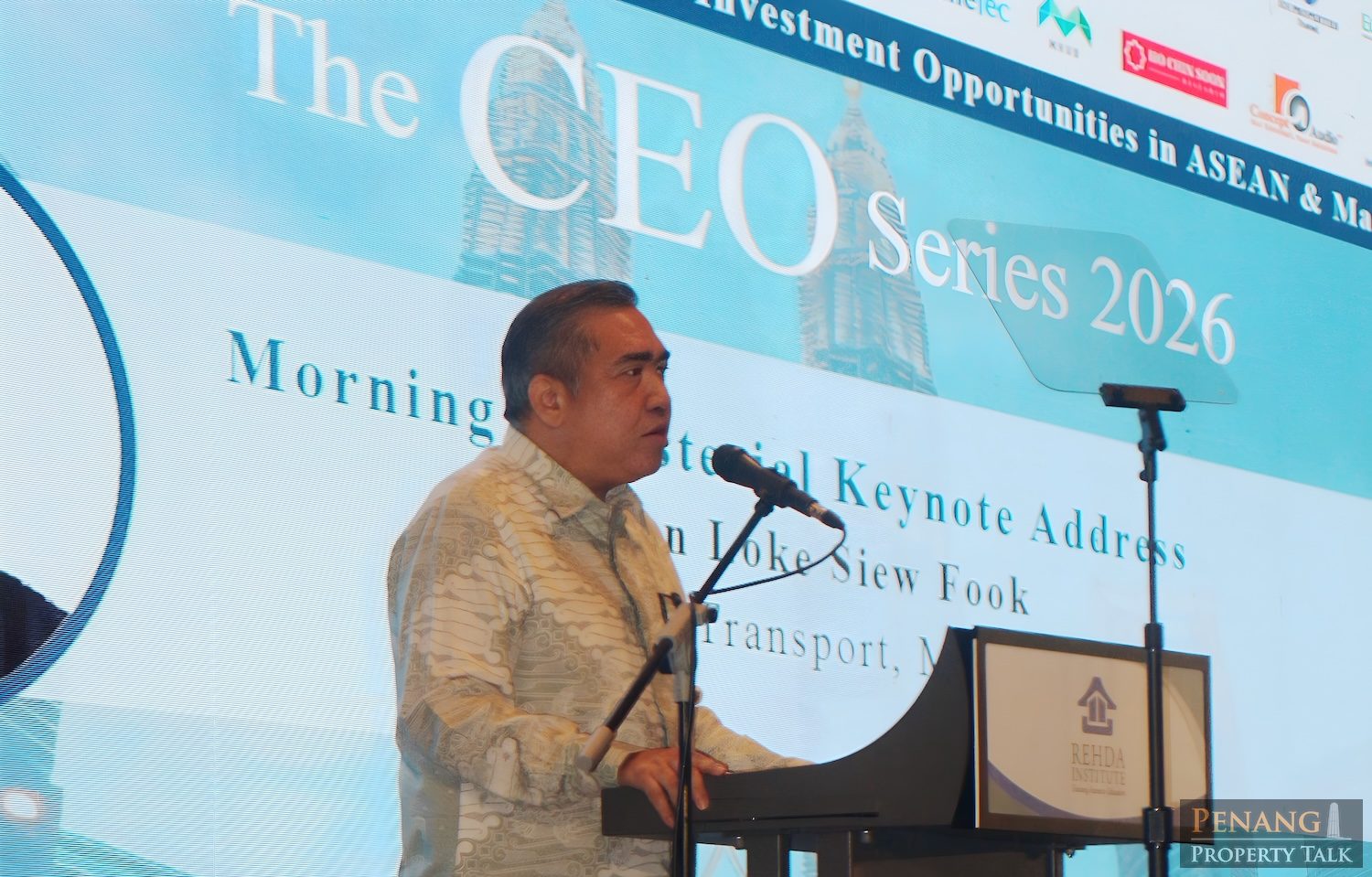
Transport infrastructure must be viewed not merely as a supporting service, but as a strategic economic enabler that directly shapes investment patterns, real estate demand and urban development outcomes, said Minister of Transport YB Loke Siew Fook at the CEO Series 2026.
Delivering the morning keynote address, the minister said 2026 will be a pivotal year for Malaysia as it coincides with Visit Malaysia Year 2026, where national targets include welcoming up to 43 million international visitors. He noted that tourism, trade and business growth depend fundamentally on the quality, reliability and integration of transport systems across the country.
From the Ministry of Transport’s perspective, initiatives to enhance air connectivity, modernise ports and improve land transport networks are not simply about moving people and goods, but about unlocking economic potential, supporting industries and creating more efficient urban environments.
Lessons from the Johor–Singapore Special Economic Zone
The minister pointed to the Johor–Singapore Special Economic Zone (JS-SEZ) as a clear illustration of how transport infrastructure underpins real estate performance and investor confidence. While the zone has attracted tens of billions of ringgit in approved and committed investments, its long-term success hinges on transport systems that can convert geographic proximity into economic productivity.
He highlighted the pressure on existing cross-border road infrastructure, with an estimated 300,000 commuters and 100,000 vehicles crossing daily, underscoring the need to diversify transport modes and relieve congestion.
Central to this transformation is the Johor Bahru–Singapore Rapid Transit System (RTS) Link, which he described as a structural economic enabler rather than a conventional rail project. With a capacity of up to 10,000 passengers per hour per direction, the RTS Link is expected to reduce travel uncertainty and enable the JS-SEZ to function as an integrated labour and business ecosystem.
Implications for Penang’s growth corridors
While the keynote focused heavily on Johor, the principles outlined carry direct relevance for Penang, where transport capacity and urban density are increasingly shaping property demand and development feasibility.
Penang’s industrial ecosystem — spanning Bayan Lepas, Batu Kawan and the Northern Corridor — depends heavily on reliable road, port and airport connectivity. As Visit Malaysia Year 2026 approaches, air links through Penang International Airport, improved last-mile connectivity and public transport integration will play a critical role in supporting tourism, services and business travel.
The minister’s emphasis on transport as a productivity enabler rather than a reactive response also resonates with Penang’s ongoing discussions around LRT, congestion management and transit-oriented development (TOD). As urban land becomes more constrained, the alignment between transport nodes, housing supply and employment centres will increasingly determine project viability and long-term value.
Transport shaping real estate outcomes
According to the minister, transport infrastructure does not merely respond to development, but actively shapes development patterns. Major investments in rail, bus corridors and intercity connectivity create new nodes of accessibility, influencing residential demand, commercial activity, industrial location and urban density.
He highlighted TOD as a critical planning tool that aligns transport capacity with housing and employment, helping to reduce congestion, improve affordability and enhance liveability. For policymakers and developers alike, transport planning therefore becomes a proactive instrument to guide sustainable real estate growth rather than a corrective measure after congestion and imbalance emerge.
Beyond capacity, towards quality and integration
Concluding his address, the minister stressed that future competitiveness will be defined not only by transport capacity, but by the quality, integration and resilience of infrastructure systems. Digitally enabled border processes, environmentally sustainable transport and seamless multimodal integration are key to transforming connectivity into competitiveness.
For Penang, as with Johor, this signals that future property and urban growth will be closely tied to how effectively transport investments are planned, coordinated and integrated into broader economic and spatial strategies, particularly as Malaysia positions itself for a more connected and competitive regional role in ASEAN