fbpx

Mah Sing targets to become proxy leader

Property News/ 25 August 2012 No comments

MAH Sing Group Bhd managing director Tan Sri Leong Hoy Kum has big ambitions, and he’s ready to articulate his aspiration for all who want to hear.

First of all, he has a vision of making Mah Sing the next Cheung Kong Holdings of Malaysia. For the uninitiated, Cheung Kong belongs to Hong Kong tycoon Li Ka-shing, and is one of the largest property developers in Hong Kong.

Like Leong, Li also started off Cheung Kong as a plastic manufacturer back in the fifties.

Some may even judge this as being a little presumptive, but Leong wants to work towards being the proxy leader of the property sector in Malaysia.

After chalking up more than 10 years of double digit growth, 39 projects ongoing and a remaining gross development value (GDV) and unbilled sales of some RM18bil, Mah Sing as a proxy leader of the sector might not be too far fetched a scenario.

Meanwhile sources added that Mah Sing was close to concluding two en-bloc sales from its existing developments in the Klang Valley to a group of foreign investors who are keen to take a bet on the Malaysian property market.

In the past, Mah Sing has concluded six en-bloc deals to both institutional and private investors.

When asked by StarBizWeek, Leong says an appropriate announcement will be made when such developments take place.

Potential proxy leader

The title of proxy leader undisputably belongs to one company over the last decade. Mention property in Malaysia, and the first company that springs to mind is S P Setia Bhd. And, of course, everyone knows S P Setia is what it is today thanks to its leader Tan Sri Liew Kee Sin.

While Liew’s Midas touch is growing in its efficacy, much of the company belongs to Permodalan Nasional Bhd (PNB) which made a general offer for S P Setia last year. Today PNB owns some 70% of S P Setia. The takeover has seen S P Setia’s sector leadership being increasingly discounted, and this is evident from its share price.

While Liew continues to steer the company for the next three years, his ownership in the company has been reduced to 5.65%.

So here comes Leong, who is focused on steering his company towards pole position by taking the approach of being a professionally-run company with an entrepreneurial spirit.

Mah Sing has delivered every quarter in terms of sales and profits over the last 10 years. As it stands, Mah Sing has a market capitalisation of more than RM2bil, putting it in sixth position. Leong is targeting Mah Sing to have a market capitalisation of RM5bil in the next 3 to 5 years.

“I have worked very hard over the past 18 years as I want to leave behind a legacy. We are building the company to be the next proxy of the property sector, by being the premier lifestyle developer that can be counted upon to deliver the results and the quality that is associated with the Mah Sing brand,” says Leong.

As Malaysia’s second biggest listed property developer by sales value, Mah Sing has the credentials for these ambitions.

Up to June 30, 2012, the company has achieved sales of RM1.29bil, which is also 52% of their 2012 RM2.5bil sales target. It has unbilled sales of RM2.69bil and a cashpile of RM555mil.

For the first half, net profit was up 42% to RM120mil on the back of a 25% improvement in revenue to RM913mil.

From 2002 to 2011, Mah Sing has enjoyed a compounded annual growth rate (CAGR) of 47% on net profits. Housebuyers who purchased Mah Sing homes, especially its landed properties, have also seen capital appreciation of more than 50% over a three to four year period.

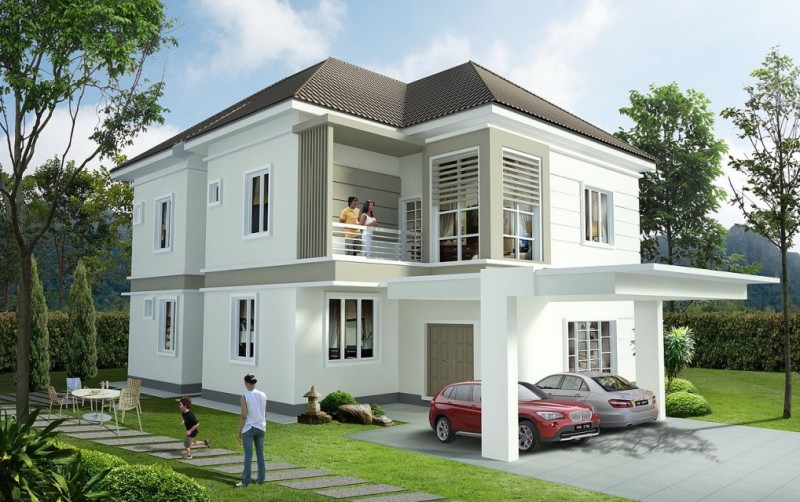
For instance, Aspen and Clover @ Garden Residence in Cyberjaya has a resort lifestyle concept with lots of lush greenery. Clover@Garden Residence for example, is set upon a hillslope and for home owners, so it is virtually having a mountain beside one’s home.

For its upcoming Ferringhi Residence in Penang which also offers the same concept but with an ocean view, registration has currently reached a cumulative 2,787 units, out of total units of 210 units.

Its M Residence in Rawang has seen registration of 2,509 units out of actual units of 779, for its linked units. Its semi-dees have seen registration of 891 units out of actual units of 68.

It is with these statistics that Leong’s conviction to achieve his sales target of RM2.5bil for 2012 has been further strengthened.

“If we buy the right land, offer the right product and right concept and launch at the right time, then I am very sure that my developments will sell. Property development is a cashflow game. You have to manage that well. To have a quick turnaround, we must target the right segment,” says Leong.

In 1994, Mah Sing was a fledgling property developer that started off as a plastic manufacturer, foraying into the development of an industrial park. Mah Sing can today boast of a remaining GDV and unbilled sales of RM18bil in Penang, Johor, Kota Kinabalu and the Klang Valley.

Over the past four years, Mah Sing has also bought over RM1bil worth of land with about RM12.6bil in GDV. It is still reasonably geared at 30%, well below management’s target of 50%.

The company is known for its small, niche and fast turnaround developments. Previously, the company never owned a single parcel of land bigger than 400 acres. Its strategy was always to roll out what buyers wanted and at the right location.

Township developer

So moving forward, what is Leong’s strategy?

For starters, he’s expanding Mah Sing’s township portfolio. Mah Sing has been developing townships since year 2000 in both Klang Valley and Johor Baru.

Projects like Garden Residence in Cyberjaya, Kinrara Residence in Kinrara, M Residence in Rawang and Sierra Perdana in Johor are mixed townships which have been received good take up rates. So now, Mah Sing is venturing into bigger acquisitions to meet market demand.

This is already evident in the sizes of land it has been buying of late. While its two projects in Rawang is about 400 acres, its Bangi land which will house its Southville City development is over 400 acres with a GDV of RM2.2bil.

Mah Sing will also bid for the Rubber Research Institute Land in Sungai Buloh, where it is hoping to get a bigger portion from the carved out parcels.

When asked for his outlook on the property market, Leong says he is selectively optimistic, especially on the middle income market.

“We have to tailor our property products to the needs of the market. From what I can see, mid to high end developments will still be in demand if they are in good locations. I am still bullish on certain market segments, For example, the market wants landed properties. Buyers don’t mind driving 15 minutes to 30 minutes to work, as long as they have a good sized link house, semidee or a bungalow. That is why my Southville City and M Residence in Rawang will cater for this need. Landed properties for the middle income group,” said Leong.

On this note, he will continue to focus on linked houses in a gated and guarded concept priced below RM1mil.

Leong is extremely excited over the launch of Southville City, as this sizeable land will provide housing which is within the reach of many middle income earners in the Southern part of KL. Southville City has prime frontage of 2km along both sides of the North South Highway, providing value enhancing branding opportunities for project.

Mah Sing is planning to seek approval from the government for a new interchange on the North South Highway just 2.5km from the existing Bangi interchange to allow direct access to Southville City. Currently, registration for Southville City has reached close to 2,500 registrants.

Leong sees Southville City changing Bangi. He feels that presently, despite the rising trend of urbanisation, locals are largely underserved.

It is on this note that the township of Southville will comprise of landed residential units, and some 30% of the landbank will be allocated for commercial properties. Leong is targeting the upgraders and new buyers from Bangi and surrounding townships of Kajang, Semenyih, Putrajaya, Cyberjaya, Nilai and Seremban. Leong adds that for serviced apartments, there is demand for units between 500 and 700 sq ft. This was especially popular among new household formations and singles.

“Nowadays people buy properties to match their lifestyle. Property is acknowledged as the best hedge against inflation, and people buy properties as a form of wealth preservation and not speculation,” said Leong.

Source: The Star

Tags:

The Cantonment

Pulau Tikus/ 25 August 2012 18 comments

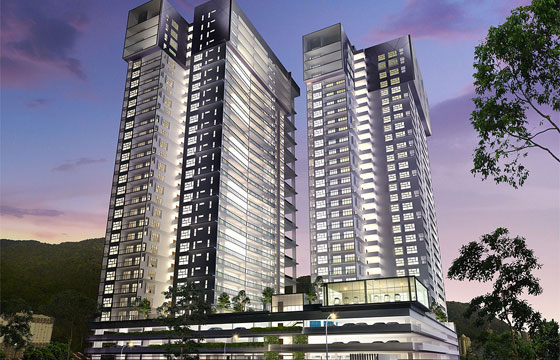
The Cantonment, a 32-storey luxury condominium in Pulau Tikus. This is a low density residential development by Melariang Sdn. Bhd. Located next to Jalan Cantonment with unit size ranging from 1,200 sq.ft. onwards. It’s excellent connectivity to the pulse of Penang gives immediate access to banks, hospital, shopping malls, restaurants, eateries, shops and a post office. This condominium is only a 10-minutes drive to Georgetown or Tanjung Tokong.

Project Name : The Cantonment
Location :
 Pulau Tikus, Penang
Property Type : Condominium
Built-up Area : 1,000 sq.ft. onwards
Total Units: 71
Land Tenure : Freehold
Indicative Price : RM850,000 onwards
Developer : Melariang Sdn. Bhd (MALTON)

Tags:

Trends @ Southbay Plaza

Batu Maung/ 24 August 2012 19 comments

Trends @ Southbay Plaza

Trends @ Southbay Plaza, a lifestyle retail mail well located on the Southern coast of Penang. With its strategic location next to the upcoming Second Link Bridge and high accessibility via the main thoroughfare, it is undoubtedly the next prime residential and retail hotspot that meets the fast-evolving living standards of a cosmopolitan island city like Penang.

Property Project:  Trends @ Southbay Plaza
Location : Southbay City, Batu Maung, Penang
Property Type : Commercial (Retail)
Built-up Area: 900 sq.ft. onwards
Total Units: 47
Land Tenure : Freehold
Developer : Mah Sing Group


Tags:

Actual sale of residential properties declining

Property News/ 24 August 2012 9 comments

PETALING JAYA: The residential property market may be cooling down in terms of actual sales due to credit-tightening measures by banks, according to real estate consultants and Bank Negara data.

Bank Negara’s website showed loan approvals’ percentage for residential properties in the country declined to 46.8% in the first half of this year from 50.1% during the same period in 2011.

The number of loans applied for purchases of residential properties increased by 2.9% year-on-year in the first half of this year to RM96.7bil.

However, the number of residential property loans approved during the six-month period declined to RM45.26bil from RM47bil in the same period in 2011.

It is also worth noting that the loan approval percentage for non-residential properties was stable at 52.3% in the first half of this year, compared with 52.4% during the same period in 2011.

The number of loans applied (RM50.35bil) and approved (RM26.35bil) for purchases of non-residential properties was also stable in the first half of this year.

CB Richard Ellis (Malaysia) Sdn Bhd executive director Paul Khong said if the housing loan approval rate continued to decline, it will affect residential property prices.

“In order to conclude transactions, residential property sellers may now need to realistically adjust their selling prices as many of the buyers cannot get their loan applications approved,” he said.

KGV International Property Consultants director Anthony Chua said although the demand for residential properties continued to be high, the credit-tightening measures by banks had resulted in the market “cooling somewhat”.

“We are still monitoring the situation. There is less transactional activity in the market this year for both new property launches and the secondary market compared with last year,” said Chua.

Property consultancy CB Richard Ellis (M) Sdn Bhd had, in its recent report on the Kuala Lumpur residential market for the second quarter of 2012, also noted that there was a significant decline in the loan approval percentage this year.

“The loan approval rate was as high as 60.5% during the first five months of 2008, and has declined steadily since,” said the report.

The CBRE report said that the lower rate of loan approvals this year could be attributed to the implementation of new lending guidelines by Bank Negara.

Effective this year, banks have started using net income instead of gross income to calculate the debt service ratio for loans.

“Anecdotal evidence from real estate agents suggests that transactional activity has also declined as a result.”

The property consultancy also pointed out that despite the lower loan approval rates, buyer interest in new property launches, typically of smaller housing units in secondary locations, during the second quarter remained strong with developers continuing to offer attractive incentives to the purchasers such as the developer interest bearing scheme (DIBS), early bird discounts, free built-in cabinets and free legal fees.

“We expect 2012 to be a period of stabilisation especially within the luxury residential market, with transactional activity depressed by uncertain economic conditions and the reduction in loan approval percentage, which remains well below 50%.”

The CBRE report also said speculative property purchases were expected to be reduced for the rest of this year, as a result of tighter lending conditions, uncertain economic outlook, and concerns about the outcome of the upcoming general election.

Meanwhile, another property consultant said the tighter lending conditions had taken a visible toll on the secondary residential property market.

“Newly-launched properties are selling well thanks to better financing access, especially with the DIBS offered by many property developers.”

The consultant said slower sales activities in the secondary residential property market had resulted in innovative offers from marketing agents.

“This includes transactions where buyers sign the sales and purchase agreement but take the bank loans only a year or twolater. In effect, the buyers lock in the unit price now (perhaps in anticipation of further increases in market prices) and defer payment until much later. This works just like an informal DIBS,” he said.

In a recent report, Kenanga Research also said based on its channel checks, the secondary market appeared to be very weak and prices of secondary and primary products have diverged further.

The research unit opined that buyers were more focussed on new launches due to financing and promotional schemes.

“From a bank’s perspective, we think there is a preference to lend to the primary market as it means better asset quality whilst banks can get all-in’ deals with developers (for example, end-financing to bridging to land financing) to ensure a more balanced systems loans growth.”

Kenanga Research also opined that as a result, property developers can continue to grab greater market share and chalk-up high sales, although it expected Malaysia’s overall residential transaction value growth to be relatively unexciting at 5% year-on-year.

It was noted that despite the tighter lending criteria, Malaysia’s total residential transaction values have remained stable in the first quarter of this year.

It said buying interest remained strong, due to residential property buyers hedging against inflation and the lack of alternative investments, but this will be reigned in by more prudent lending criteria and the banking system’s fear of real-estate tightening measures such as higher real property gains tax.

Source: The Star

Tags:

The resurrection of Sungai Pinang

Property News/ 24 August 2012 No comments

SUNGAI PINANG can only be filth-free if Penangites stop treating it as a rubbish dump.

The fishing community that has lived by the river bank for decades are upset that their home has been used as a dump for years.

Welcoming reports that the river would be devoid of garbage within three years, Shaaban Che Amat, 60, said some 100 fishermen living there were tired of the recurring flash floods and pollution.

“It’s good that the Penang Drainage and Irrigation Department (DID) has been cleaning and dredging the river but sometimes, the work is not done well.

“For instance, when the soil is dredged, it is not removed from the river but merely transferred to the other side of the bank and when rubbish accumulates, we are back to square one — our boats cannot go out to sea and we are stuck for hours in shallow waters.

“Sometimes after a heavy downpour, you can find old television sets, furniture and huge black plastic bags floating near our boats by the jetty.

“The river can be rubbish-free but only if Penangites stop treating it as a dump,” he said when met at the Sungai Pinang jetty in Jelutong, Penang, yesterday.

Shaaban, who has been a fisherman there for the last three decades, said he often saw people getting out from their vehicles parked beside the road, to dump bags of rubbish into the river.

Mohd Shariff Abu Bakar, 60, agreed.

“We grew up in Kampung Selut by the Sungai Pinang river bank and I remember there being lots of prawns, fishes and crabs but that was 20 years ago.

“It seems like the more developed we become, the dirtier our habits are,” he said.

Amir Ali Basamiah, 64, said everyone must work together if Sungai Pinang is to be clean again like it was before the 1970s.

“It was only in the 1970s when an abattoir, car workshops and factories started mushrooming here and it marked the start of Sungai Pinang’s woes,” he said.

Penang Municipal Council (MPPP) Public Health Standing Committee alternate chairman Ong Ah Teong said the council was diligently working to clean up George Town under the state’s ‘Cleaner, Greener, Penang’ campaign.

“There is strong emphasis on the roads and drainage systems because it is related to flash floods.

“Some garbage traps in the river and litter hotspots especially those around the river banks are cleared daily,” he said.

From being among the ‘stinking seven’ most polluted rivers in the country five years ago, Sungai Pinang is slowly but surely making its way to Class II from its present Class III Water Quality Index rating and the DID is aiming to make Sungai Pinang waste-free by 2015.

Sungai Pinang had been categorised as a Class III river since 2008 but in September 2007, it received the MS ISO 14001:2004 Environmental Management System certification for its river management.

The river was classified under Class V as most polluted with no marine life before an initial allocation of RM20mil was spent on the first phase of rehabilitation which was completed in 2007.

So filthy was the river then that when Sungai Pinang assemblyman Koid Teng Guan jumped into a dirty shallow end to get mud and water samples, he ended up seeking medical treatment for the rashes on his feet.

State Health, Welfare, Caring Society and Environment Committee chairman Phee Boon Poh said it was unfair to blame those living along Sungai Pinang for the floating garbage.

“It’s a Catch-22 situation because when there are flash floods, garbage from the litter-filled roads are washed into the river which in turn, clog up the waterway and when there’s another heavy downpour, flash floods would recur.

“Since 2009, the state government has engaged the community, private sector, non-governmental organisations and relevant government departments on an awareness campaign to clean up the river.

“The state government’s message is very clear — we are determined to act against those who pollute the river but we want to make them understand the importance of keeping the river clean as it also helps prevent flash floods from occurring,” he said.

Phee said individuals and business premises in the area had been issued notices indicating that those caught discharging effluents would be compounded a minimum of RM10,000.

A three-year project to enhance community participation in the protection and rehabilitation of the severely polluted Sungai Pinang was launched in July last year.

The RM100,000 Sungai Pinang River Care project, to be carried out in phases, is funded by HSBC Bank Malaysia Berhad in partnership with Global Environment Centre.

On June 25, DID director Anuar Yahya said waste collected from the 3.1km-long river was reduced by more than 50% with the implementation of the Sungai Pinang River Care project.

He said currently, the amount of rubbish collected from the river had significantly reduced to nine tonnes per month compared to that of previous years.

Phee said two main milestones which led to the cleaner river were the closure of the island’s last remaining rubber factory in March and the diversion of waste water from a nearby abattoir directly to the IWK waste treatment plant in Jelutong.

The factory was identified as one of the causes of the river’s pollution.

It had caused air and water pollution by discharging effluents into Sungai Dondang which flowed into Sungai Air Itam and subsequently Sungai Pinang.

He said the state government was working closely with the fisheries department and fish breeders to identify a suitable species for the river.

“We want to introduce fishes into the river to further help clean it up but the species chosen must not be harmful to the eco-system. We are looking at ‘non-aggressive’ fishes that feed on plankton and not each other,” he said.

Rainwater from Sungai Dondang and Sungai Air Itam flows into Sungai Pinang, causing the river banks to burst so every time there’s prolonged rain, those living nearby spend sleepless nights worrying about waking up in knee-deep water.

With squatter relocation still a problem for the RM150mil Sungai Pinang flood mitigation project, a clean waterway is crucial as a clogged river littered with rubbish has made Sungai Pinang the most flash flood-friendly area in Penang.

To check on Sungai Pinang’s updated water quality index readings, visit www.sungaipinang.wqms.info.

Source: The Star

Tags: