

Penang has set aside 10 acres of land in Batu Kawan, valued at approximately RM40 million, for the development of a new Automation, Test and Equipment (ATE) Campus aimed at strengthening the state’s semiconductor ecosystem. The initiative is part of a broader effort to bring together local and international companies within the ATE subsector, creating a collaborative hub that supports innovation, talent development and supply chain integration.
Chief Minister Chow Kon Yeow said the state government, through the Penang Development Corporation (PDC), is supporting the initiative as part of its long-term strategy to enhance local capabilities within the manufacturing sector. He noted that while Penang continues to attract strong foreign investments, developing stronger local participation remains essential.
According to Chow, many local companies in Penang already possess significant experience, with some having operated for more than three decades while others have built up two decades of industry expertise. Strengthening these local players will help them grow further and contribute more meaningfully to the state’s industrial ecosystem. He emphasised that nurturing local capabilities will be a gradual process, but it is necessary to ensure Penang does not remain solely dependent on foreign capital.
The proposed ATE Campus is also expected to unify different parts of the ATE supply chain, encouraging collaboration among industry players. The initiative follows earlier efforts by the state to strengthen its semiconductor value chain, including the IC design initiative introduced in 2024. Through these initiatives, Penang hopes to attract more investments while developing the talent needed to support a more complete and resilient technology ecosystem.
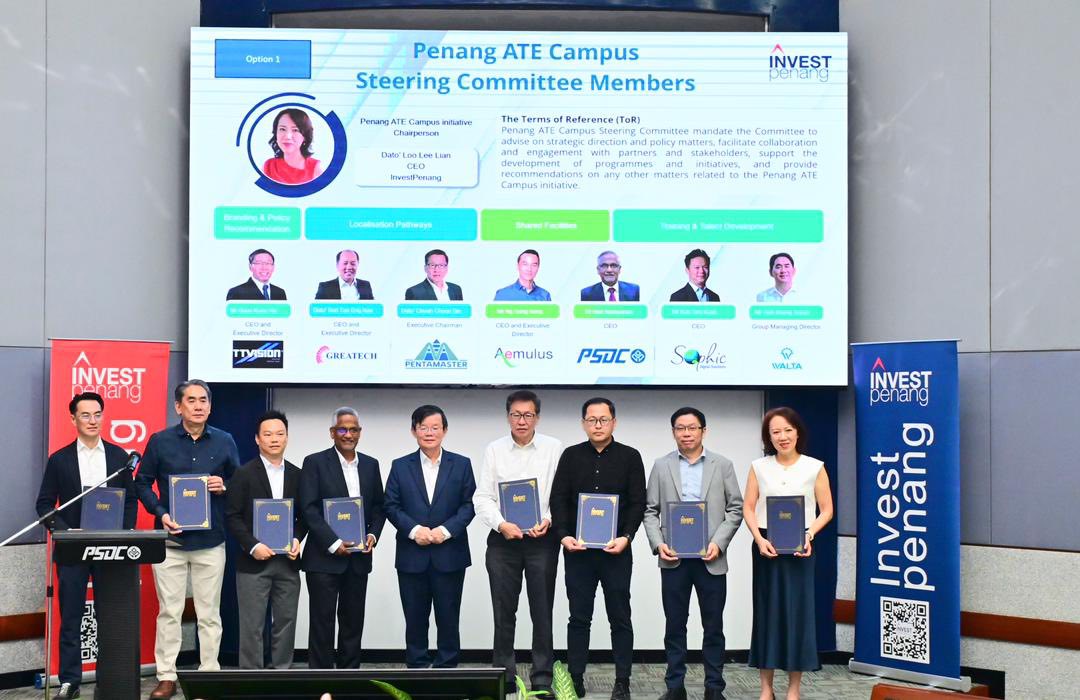
InvestPenang chief executive officer Datuk Loo Lee Lian said the future campus in Batu Kawan will function as both an innovation centre and a collaboration hub for ATE companies. The facility is expected to house local firms while also providing opportunities for foreign companies to work alongside Malaysian organisations in research, training and technology development.
While the dedicated campus may take two to three years to materialise, collaboration among industry players has already begun. For instance, the Penang Skills Development Centre (PSDC) is currently providing space for a laboratory to support early-stage activities before the permanent campus is developed.
InvestPenang is also preparing a proposal to seek funding support from the federal government, including agencies such as the Malaysian Investment Development Authority (MIDA) and the Ministry of Investment, Trade and Industry (MITI). The proposal, expected to be submitted by mid-year, will outline funding requirements for shared laboratories, training programmes and collaborative initiatives between multinational companies and local firms.